An enclosure body can be built two ways: cut flat panels and weld them into a box, or draw a single blank into a seamless shell. The welded vs deep drawn enclosures decision is a straight trade between fixed cost and recurring cost. Welding needs little or no tooling. However, it consumes labour on every unit: tacking, welding, grinding, straightening and polishing. Drawing needs real tooling investment but then produces a finished shell in a press cycle with no seams to close and no welds to dress.
The other half of the decision is functional. A drawn shell has no seams. Therefore, it has no leak paths through the body, no weld porosity, no distortion from heat input and no ground-back weld beads to blend. If the enclosure must be sealed, pressure-retaining or cosmetically flawless, that structural difference often decides the matter. As a result, the cost comparison comes second.
Where drawing loses is geometry and flexibility. Draw ratio limits how deep a shell can be relative to its opening. Sharp rectangular corners are difficult, and very large enclosures exceed practical press capacity. In addition, any design change means new tooling. This guide sets out where each construction genuinely wins.
How welded vs deep drawn enclosures are built
Welded construction
Panels are cut — usually laser cut — then bent on a press brake, positioned in a fixture, tacked, welded and dressed. Our 3,200 mm press brake forms panels up to that length in a single stroke, and joining runs through laser welding, TIG, MIG or spot welding depending on the material, thickness and the appearance required.
The strength of this route is that almost any geometry is achievable. Rectangular boxes with sharp corners, enclosures with internal partitions, mounting bosses, cable entries and cut-outs anywhere — all straightforward. It also requires no hard tooling, so the first unit can ship quickly and the design can change between batches.
The cost, quite literally, is labour. Every seam must be welded and, if the enclosure is visible, ground flush and polished. Heat input distorts panels, so fixturing and weld sequencing matter. On stainless, heat tint must be pickled off and the surface passivated.
Deep drawn construction
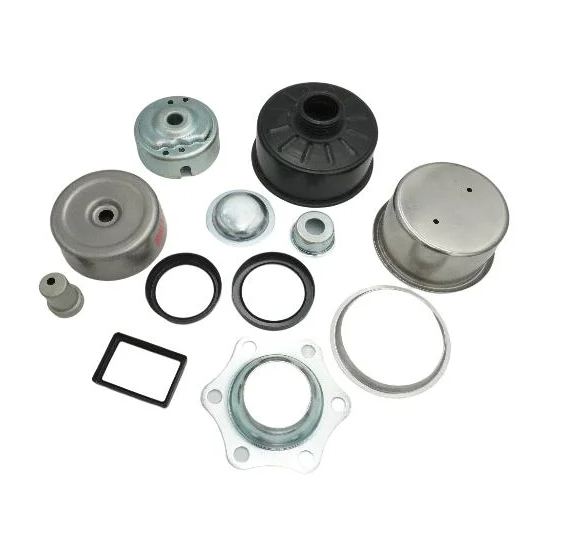
A blank is clamped and a punch draws it through a die, forming a one-piece shell with a continuous wall and no seams. Depth beyond roughly half the diameter requires successive redraw stages, then the open end is trimmed to length. Our deep drawing line runs multi-stage forming with typical tolerances around ±0.10 mm.
The advantages follow directly from having no seams: nothing to leak, nothing to grind, nothing to distort. Each unit is identical to the last because the die does not vary the way a welder’s hand does. Corner radii are naturally generous, which is good for sealing and for coating adhesion. Consequently, drawn shells suit protective and decorative finishes well.
The limits are equally direct. Tooling must be built and paid for. Draw ratio constrains depth. Sharp rectangular corners fight the process. And a design revision after tooling is cut is expensive.
Welded vs deep drawn enclosures: sealing settles most cases
For any enclosure with an IEC 60529 IP rating requirement, count the potential leak paths in each construction.
In a welded box, every seam is one. A continuous, full-penetration weld properly executed is leak-tight — but “properly executed” is doing real work in that sentence. Porosity, undercut, a stop-start defect or a crater at a corner junction each create a path. Corners where three welds meet are the classic failure point. Leak testing on welded enclosures is therefore not optional for sealed applications; it is part of the process.
In a drawn shell, the body has no seams at all. The only sealing interfaces are the ones you deliberately designed: the door or lid gasket, and any cable gland or connector penetration. That is a smaller, better-controlled set of variables, and it is why drawn construction is common for sealed instrument housings and sensor bodies.
Corner geometry reinforces the point. A drawn shell has smooth radiused corners that a gasket can follow continuously. A welded box has a ground weld bead at each corner, and gaskets seal poorly across an uneven bead. Achieving the same sealing reliability in welded construction requires machined sealing faces or a continuous gasket channel — both add cost.
Welded vs deep drawn enclosures: comparison table
The table below compares the welded vs deep drawn enclosures options side by side.
| Criterion | Welded enclosure | Deep drawn enclosure |
|---|---|---|
| Tooling investment | None or minimal fixturing | Significant — multi-stage die set |
| Labour per unit | High — weld, grind, straighten, polish | Low — press cycle plus trim |
| Seams in body | Multiple | None |
| Sealing reliability | Depends on weld quality; leak test needed | Inherent in the body; only designed joints seal |
| Geometry freedom | Very high — any box, partitions, features | Constrained by draw ratio and corner radii |
| Size range | Up to 3,200 mm panel length | Limited by press and die size |
| Depth capability | Unrestricted | Governed by draw ratio and stage count |
| Sharp corners | Achievable | Difficult — radii are inherent |
| Distortion risk | Present — heat input | Minimal — no heat |
| Cosmetic finishing | Grinding and polishing required | Little or none on the body |
| Unit-to-unit consistency | Operator-dependent | Die-controlled, highly repeatable |
| Design change cost | Low | High once tooling exists |
| Best-fit volume | Low to medium | Medium to high, stable |
Welded vs deep drawn enclosures: where the cost actually goes
Buyers comparing the two routes often compare only the piece price at their current volume and miss the shape of the curve. A proper welded vs deep drawn enclosures comparison prices the whole curve.
Welded construction has a flat cost curve. The tenth unit costs close to what the thousandth costs, because welding and grinding labour do not scale away. Some efficiency comes from better fixturing and operator familiarity, but the floor is set by the time it physically takes to lay and dress a weld.
Drawn construction has a steeply falling curve. The tooling is paid once, and after that the marginal cost is a press cycle. As volume rises, the tooling cost divides down until it becomes a rounding error against the labour it eliminated.
Two costs are routinely underestimated when the two are compared:
- Weld dressing on cosmetic enclosures. Grinding a weld flush and polishing it to a uniform brushed finish is skilled manual work, and on a visible enclosure it can rival the welding time itself.
- Rework from distortion. Heat input warps panels. Straightening after welding, or scrapping an assembly that will not sit flat, is a real recurring cost that rarely appears in a piece-price comparison.
The corollary is that the crossover point is not a fixed volume. It moves with how cosmetic the enclosure is, how many seams it has, and how tight the flatness requirement is. A plain internal chassis crosses over late; a polished stainless housing with a demanding gasket face crosses over early.
When geometry forces welded construction
- Enclosures too large for practical die and press capacity.
- Depth beyond what the draw ratio allows for the material, even across multiple redraws.
- Sharp rectangular corners that the design cannot compromise on.
- Internal partitions, shelves or structural ribs that cannot be formed from one blank.
- Variable-thickness sections, or different materials in different areas.
- Designs still in revision, where committing to hard tooling would be premature.
- Volumes too low to amortise the tooling under any reasonable assumption.
When drawn construction wins clearly
- The enclosure must be leak-tight, and reliably so across every unit.
- The body is visible and a seamless appearance is worth paying for.
- Volumes are stable and repeat over several years.
- Wall consistency and dimensional repeatability matter more than geometric freedom.
- Downstream finishing labour is a significant share of current cost.
Welded vs deep drawn enclosures: a hybrid is often the real answer
The two routes are not mutually exclusive. In fact, the cheapest enclosure frequently combines them. A drawn shell forms the sealed body while a laser-cut, bent and welded lid, bracket set or mounting frame handles the features that drawing cannot produce. Hardware such as PEM studs, standoffs and earth bosses is pressed in afterwards regardless of which route the body took.
Deciding this well requires a supplier that runs both processes rather than one. A shop with only press brakes and welders will propose a welded box; a shop with only draw tooling will propose a shell. Both run in our plant under one ISO 9001:2015 system, alongside welding and assembly, which means the route can be chosen on the part rather than on the equipment list. The same logic applies when engineers weigh deep drawing vs metal stamping for a new part. The same reasoning applies across our enclosure work and outdoor telecom cabinets.
Inspection differences worth planning for
Welded enclosures need weld inspection: visual examination against acceptance criteria, dye penetrant testing where welds are critical, and leak testing for sealed units. Flatness and squareness need checking after welding because heat input moves things. Each of these is an inspection operation with a cost attached.
Drawn shells need different checks: wall thickness at the thinnest point, which is typically just above the punch corner radius; dimensional verification of the controlled diameter; and inspection for any drawing defect such as tearing or wrinkling. There is no weld to test, which removes a whole inspection category.
Both routes pass the same four gates in our plant — incoming material, first article, in-process sampling and final AQL inspection per ISO 2859-1 — but the content of those checks differs by construction, and that difference should be reflected in the drawing’s inspection requirements.
Welded vs deep drawn enclosures: frequently asked questions
Are deep drawn enclosures better sealed than welded ones?
Generally yes, because a drawn shell has no seams in the body and therefore no weld-related leak paths. A properly executed continuous weld can also be leak-tight, but it depends on weld quality across every unit and normally requires leak testing to confirm. Drawn shells also offer radiused corners that gaskets seal against more reliably than a ground weld bead.
At what volume does deep drawing become cheaper than welding?
There is no universal figure. The crossover depends on how much welding and grinding labour the welded version requires and how many draw stages the geometry needs. Cosmetic enclosures with many seams cross over at much lower volumes than plain internal chassis. Compare total cost including finishing labour and rework at your realistic annual volume rather than comparing piece price alone.
How deep can a drawn enclosure be?
Depth is governed by the limiting draw ratio of the material and the number of redraw stages, not by a single fixed limit. A first draw typically achieves a depth of roughly half the diameter, with successive redraws going deeper at a reducing rate. Deep parts in stainless may need interstage annealing between draws.
Can a deep drawn enclosure have sharp corners?
Not truly sharp ones. Drawing inherently produces radiused corners, and forcing tight radii concentrates strain and causes tearing. If the design requires sharp corners for appearance or fit, choose welded construction. Alternatively, review the design to see whether a radius is acceptable.
Which construction handles design changes better?
Welded construction, decisively. Changing a cut-out, a dimension or a feature means editing a DXF and adjusting the fixture. On a drawn part, a change to the shell geometry usually requires new tooling. This is why designs that are still evolving should stay welded until they stabilise.
Can the two constructions be combined in one product?
Yes, and it is common. A drawn shell forms the sealed body while a fabricated lid, bracket or internal frame provides the features drawing cannot produce. Hardware insertion, finishing and assembly then proceed identically for either route.
Send the enclosure drawing and the annual volume
The welded versus drawn question is best answered by looking at the actual geometry alongside the volume, since either input alone gives the wrong answer. Send both and an engineer will assess draw feasibility, estimate stage count, identify the finishing labour in the welded alternative, and return a quotation within 3 business hours. Email xcwystamping@xcwybj.com or use the quote request form.
Need a decision on your part?
Send your drawings for an engineering review — pricing plus DFM feedback within 3 business hours. MOQ from 1 pc, NDA on request.
Leave a Reply