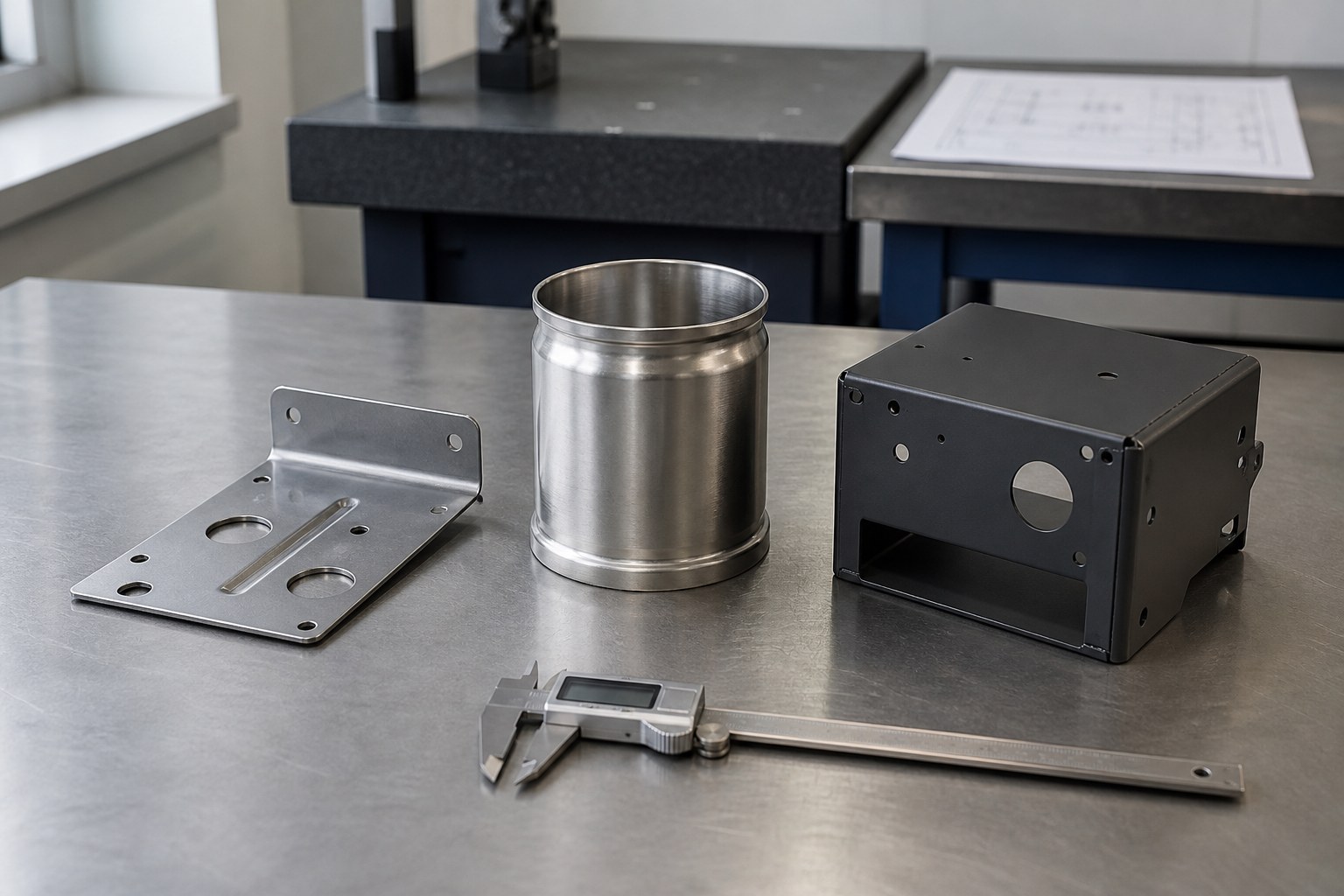
Every custom metal part you buy travels one of three routes: through an on-demand platform that quotes it instantly and routes it into a supplier network, through a digital manufacturer that runs it in its own plants, or through a single factory you qualify yourself. The route decides your unit cost, your tooling ownership, your lead time and who you call when the second shipment does not match the first. This page compares all three on the numbers, including the cases where a platform is genuinely the better answer.
In short: if you need prototype parts in three days to a US address, buy from a platform. If you need 5,000 parts a year with tooling you own and a unit cost that falls as volume rises, buy from a factory — and qualify it properly. XCWY is the third route: one plant in Nanpi County, Hebei, quoting from your drawing within 3 business hours, with the tooling built in-house and owned by you.
The three routes in one table
| Dimension | On-demand platform (e.g. Xometry) |
Digital manufacturer (e.g. Protolabs) |
Direct factory (XCWY) |
|---|---|---|---|
| How you get a price | Upload a 3D model, instant automated quote | Upload a model, automated quote | Send a drawing; an engineer reviews it and quotes within 3 business hours |
| Who actually makes it | A supplier in their network, selected by their algorithm | Their own plants | One plant, Nanpi County, Hebei — the same one every time |
| Typical best use | Prototypes, spares, low-volume, many processes in one basket | Prototypes and short runs, especially where US domestic shipping is required | Scheduled production where tooling economics and unit cost dominate |
| Standard lead time | From 3 business days (published) | 3-day and 5-day published tiers | Quoted against your programme; first articles typically 3–4 weeks including tooling |
| Order size | No minimum order volume (published) | Prototype-friendly quantities | MOQ 1 pc for validation, then scheduled reorders |
| Tooling | Proprietary to the supplier executing the order | Held by Protolabs | Built in-house and paid for by you; the tooling is your asset and moves with you |
| Price structure | Contains the platform margin on top of supplier cost | Contains the plant’s margin and US cost base | Process cost plus tooling amortisation; the unit price falls as the tooling is amortised |
| Certifications shown | ISO 9001, AS9100D, ISO 13485, IATF 16949; ITAR registered | ISO 9001 (and process-specific approvals) | ISO 9001:2015, registration 34025Q30296R0S. No AS9100, no ITAR — stated plainly so you can rule us out fast if you need them |
| Design feedback | Automated DFM flags | Automated DFM flags | A named engineer’s comments on your drawing before the tool is cut |
| Communication | Through the platform | Through the platform | Direct with the people making the part |
Three of those rows decide almost every real decision: who actually makes it, who owns the tooling, and how the price is structured. Everything else is logistics.
How each route quotes your part
A quote is not a price — it is a set of assumptions. The three routes make those assumptions differently, and that difference shows up months later.
Platform quoting: instant, automated, assumption-light
The platform route is genuinely excellent at one thing. Xometry’s Instant Quoting Engine takes a CAD file and returns pricing, lead time and an automated DFM read in minutes, with published tolerances as tight as ±0.005 in and no minimum order volume. Protolabs does the same for sheet metal with published 3-day and 5-day tiers, and free standard shipping within the US.
What the automated quote cannot see is anything that is not in the model. It cannot tell you that your bend sequence will not clear the tooling, that the hole pattern will distort when the flange is formed, or that a pressed stud in 1.5 mm sheet needs matched installation tooling or it will spin under torque. Those are exactly the issues that stop a production run, and they are found by someone looking at a drawing — not by an algorithm looking at geometry.
Digital manufacturer quoting: instant, with the plant’s own constraints baked in
Protolabs’ model is closer to a factory: the parts run in their plants, so when the automated quote accepts a part, the plant’s real capability is behind it. The trade-off is bound to their process window and their cost base. Their published sheet metal service is built around defined capability-to-lead-time maps, which means work outside that window — unusual geometries, in-house tooling, high repeat volumes — is not really what the model is for.
Factory quoting: slower to receive, far more information in it
At XCWY the quote starts with a person reading your drawing. The return is within 3 business hours, and it comes back with the process route attached: which press, which tooling, what we would change to avoid a problem you have not hit yet. On a recent enclosure programme that meant telling the customer their original design could not be formed as drawn, and quoting the corrected route instead of the wrong one.
That review is the whole reason the quote is not instant. It is also the reason a factory quote can be several hundred dollars more expensive on the first order and several thousand cheaper by the third.
Where the money actually goes
| Cost line | Platform | Digital manufacturer | Direct factory |
|---|---|---|---|
| Unit conversion cost | Supplier cost + platform margin | Plant cost + margin | Process cost at Chinese labour and overhead |
| Tooling | Charged, and usually retained by the executing supplier | Charged, retained by the plant | Charged once, owned by you, reusable on reorders |
| Amortisation | Tooling recovered inside each unit price | Recovered inside each unit price | Falls out of the unit price once the tool is paid for |
| Freight | Quoted per order | Free standard US shipping; international pricing includes tariffs | Quoted per shipment, Incoterms agreed up front |
| Engineering change | Re-quoted, sometimes re-tooled by a different supplier | Re-quoted against the plant’s process | Reviewed by the engineer who quoted it |
| Cost curve as volume rises | Broadly flat — you pay a per-unit conversion price each time | Broadly flat | Falls: the tool is already amortised and the press run is faster |
This is the single most misunderstood line in sourcing, so it is worth stating plainly: a platform’s unit price does not fall as your volume rises, because nothing about their cost structure changes. A factory’s unit price does, because you stopped paying for the tool after the first order. Somewhere between a few hundred and a few thousand parts a year, that crossover is larger than any difference in the quoted piece price.
Tooling ownership: the switching cost nobody puts in the spreadsheet
When a platform routes your order into its supplier network, the tooling that gets built is proprietary to whichever supplier executes the job. Ask to move the order elsewhere and the answer is usually that you start again. On a compound die that is not a small restart.
At XCWY the tooling is your asset. It is quoted as a separate line, paid once, and it stays yours — which means the second year of a programme is cheaper than the first, and a decision to move the part does not throw away the tool investment.
What happens when something goes wrong
Route choice decides who you contact on a bad shipment, and how many people are between you and the machine.
When a platform is genuinely the better answer
Any comparison that cannot say this is an advertisement. Choose the platform route when:
- You need parts in three days. Published 3-business-day lead times are real, and a factory quoting first articles in three weeks cannot compete with that.
- You need US domestic shipping, or your programme requires it by contract.
- You need AS9100D, ISO 13485, IATF 16949 or ITAR. Xometry holds all of these. XCWY holds ISO 9001:2015 only. If your part is aerospace, medical or defence, a platform or a certified domestic shop is the correct route — and we will tell you so rather than take the order.
- You need five processes in one basket — machining, sheet metal, 3D printing and finishing — for a one-off build.
- You are still exploring the design and expect to re-quote ten times in a month.
- Order value is too small to justify qualifying a supplier.
When a direct factory is the better answer
- The part is going into production and will repeat. Tooling amortisation changes the unit price in a way platforms structurally cannot.
- You want to own the tooling. Especially on progressive and compound dies, where the tool is the real asset.
- Your part is a stamping, a deep drawn housing or a formed fabrication — the processes where a factory’s in-house tooling and press capacity are the whole cost story.
- You need someone to change the design to make it manufacturable, not just flag that it is not.
- You want the same people on the third order as on the first.
The real question is not which is cheaper — it is which fails better
A platform fails visibly and cheaply: the order is late, you re-quote, you move on, you lost a week. A factory fails expensively if it is badly qualified: tooling that never produces a good part, tolerances that drift, a second batch that does not match the first. The asymmetry is why qualifying the factory route properly matters more than getting a lower quote from it.
The qualification itself is not complicated, and it is measurable. Ask for the ISO certificate number and verify it on the issuing body’s register rather than trusting a logo. Ask which press a part will run on and how many tonnes. Ask for the inspection record from the last batch of a comparable part, not a sample they pulled for you. Ask what happens to the tooling if you leave. Get the first article inspected against your drawing before authorising volume. Twelve checks, most of them over email.
Related Reading
Frequently asked questions
Is Xometry cheaper than buying from a Chinese factory?
It depends entirely on volume. For one-off and prototype quantities, a platform is often cheaper once you count the time and freight involved in qualifying a factory. For repeating production, a factory is usually cheaper because the tooling is amortised and stops loading the unit price. A platform’s per-unit conversion cost does not fall with volume; a factory’s does.
What is the minimum order quantity for custom metal parts?
Xometry publishes no minimum order volume, and Protolabs is built for prototype quantities. XCWY quotes from 1 pc for validation. There is no technical reason a stamping or a deep drawn part needs a large minimum — the practical minimum is set by whether the tooling cost can be justified on that order.
Can a Chinese factory hold the same tolerances as a platform supplier?
On the processes that matter here, yes. XCWY cuts on a 12,000 W fibre laser holding ±0.05 mm on the profile, forms on a JFY TPR8-100 press brake holding ±0.5° on angle, and runs presses from 25 to 400 tonnes. Xometry publishes tolerances as tight as ±0.005 in (0.127 mm), which our laser profile tolerance is comfortably inside. The honest limit is not the machine — it is whether the factory inspects and documents it, which is why we ship batch-tied inspection records.
How much slower is a factory quote than an instant platform quote?
XCWY returns a drawing review and quotation within 3 business hours. That is slower than an automated instant quote and it is deliberate: the returned quote includes a process route, tooling comments and any design changes we would make. An instant quote cannot see a bend sequence that will not clear the tooling; an engineer reading the drawing can.
Who owns the tooling when I order through a platform?
In most cases the executing supplier does. When a platform routes your job into its network, the die or fixture built for it is proprietary to whichever plant ran it, so an order moved elsewhere generally means starting the tool again. At XCWY tooling is quoted as a separate line, paid once and owned by you, which is what makes the second order cheaper than the first.
Can I get a prototype before committing to production tooling?
Yes. Most programmes start with a validated sample or a single-cavity trial tool, inspected against your drawing before volume is authorised. If the part is complex, we would rather spend the tooling money in stages than commit it all to a design that has not been proven in metal.
What certifications does XCWY hold, and what does it not hold?
XCWY holds ISO 9001:2015, registration 34025Q30296R0S. We do not hold AS9100, ISO 13485 or IATF 16949, and we are not ITAR registered. If your programme requires any of those, Xometry holds all of them and a platform or certified domestic supplier is the correct route for that part.
How do I verify an ISO 9001 certificate is real?
Take the registration number from the certificate and look it up on the issuing certification body’s own online register, not on the supplier’s website. A valid certificate resolves to the legal entity you are contracting with and to a scope that covers the process you are buying. XCWY’s certificate resolves to Nanpi Xinchengweiye Hardware Products Co., Ltd. under registration 34025Q30296R0S.
What happens if the first batch is out of tolerance?
The batch is held, the inspection record is opened, and the out-of-tolerance feature is measured against the drawing to establish whether it is a tooling issue or a process drift. Because every shipment carries batch-tied records, the same engineer who inspected it can identify which run the parts came from and what changed. Remedy is rework, replacement or a corrected tool, agreed before anything ships.
Which route should I choose for about 500 parts a year?
At 500 parts a year the tooling usually pays back inside the first or second order, so the factory route is generally the cheaper one over a two-year programme — provided the tooling is yours and the unit price drops after it is amortised. If the part is still changing frequently, or the annual volume is below roughly 100 units on a tooled process, a platform’s flexibility is usually worth more than the unit-cost saving.
Read the process pages behind this comparison
Where we show real programmes rather than claims: a 200-unit custom enclosure build, an outdoor BESS enclosure programme, and hygienic stainless fabrication. Each one lists the tolerances held, the inspection method and the documentation that shipped with it.
Send your drawing and get it back reviewed. One engineer reads it, and you get a process route, tooling comments and a price within 3 business hours — including whether we are the wrong route for your part.
Leave a Reply