Outdoor BESS Enclosures: A Battery Storage Fabrication Case Study From XCWY
Battery energy storage systems live and die on the enclosure. The cells are standard; the housing is not. It has to keep moisture out for a decade, hold heavy racking under wind load, pass ventilation and fire-safety review, and still ship at a cost the integrator can defend to its investor. This case study walks through how we fabricated a family of outdoor battery energy storage enclosures at our Nanpi plant — the process route, the sealing details and the numbers that mattered.
In short: an energy storage integrator (anonymised for confidentiality) ordered outdoor BESS enclosures in three sizes, built from galvanised steel with gasket-channel formed doors, weather-rated powder coating and full CMM inspection. First article passed on the first review; production ran to schedule with EN 10204 certificates shipped with every batch.
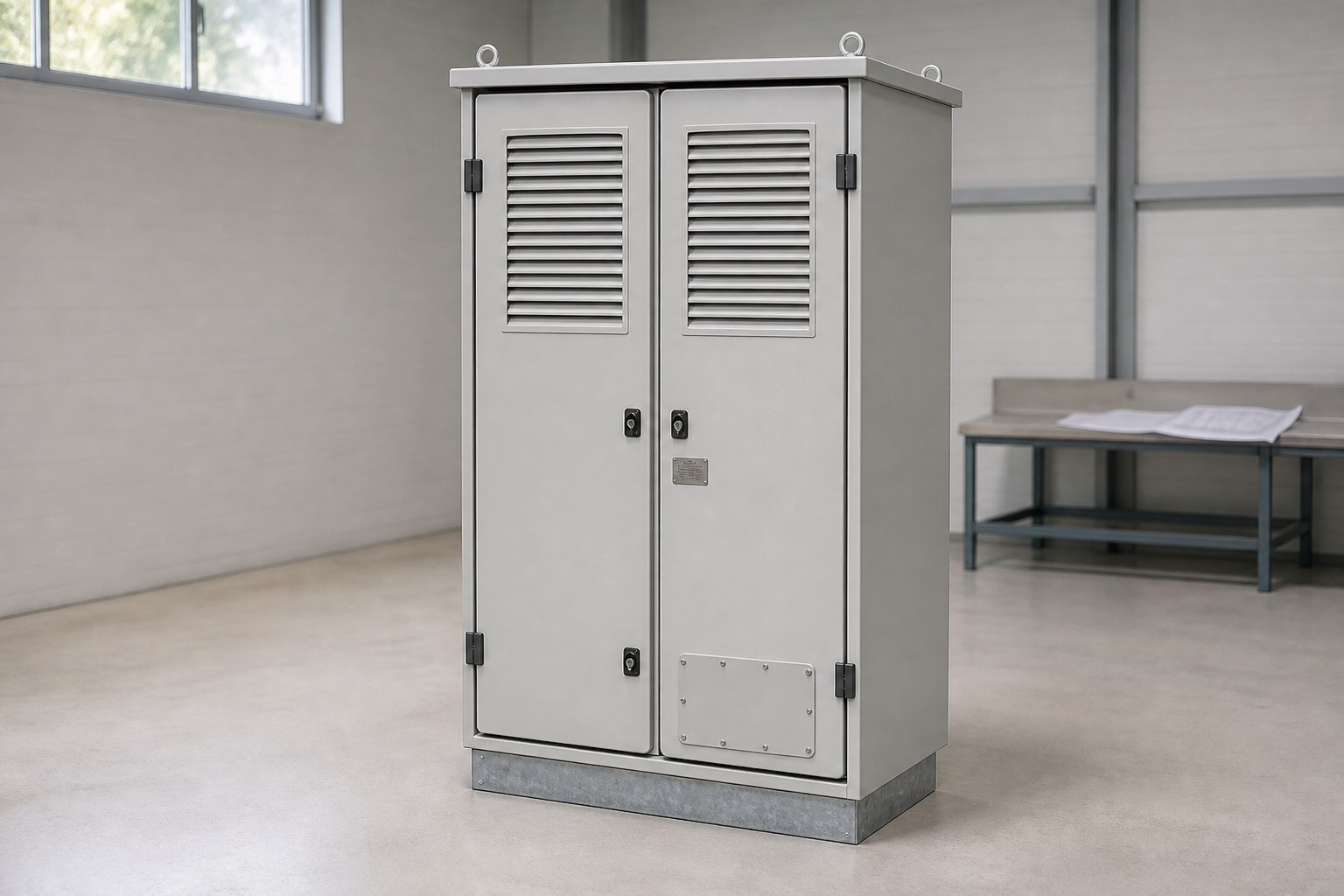
The Project
The scope was a modular range of outdoor enclosures for battery racks and power conversion equipment: roughly 1,400 × 1,000 × 2,200 mm, 1,000 × 800 × 2,000 mm and 800 × 600 × 1,800 mm, all fabricated from 1.5 mm and 2.0 mm galvanised steel. The non-trivial part was not the bending — it was everything around it:
- Gasket-channel formed door frames with continuous foam seals for IP54-class outdoor service
- Ventilation louvers and cable glands positioned to clear internal racking
- Threaded PEM studs and weld-nuts for the internal mounting rails
- Two-coat outdoor powder system over a galvanised base for salt and humidity resistance
- Door-frame squareness held tight enough that doors close first time, every time
The integrator had previously bought enclosures from two different suppliers — one cut and formed, one finished — and reconciled the gaps itself. With XCWY the whole housing came from one floor.
How We Built It
Stage 1 — Laser Cutting
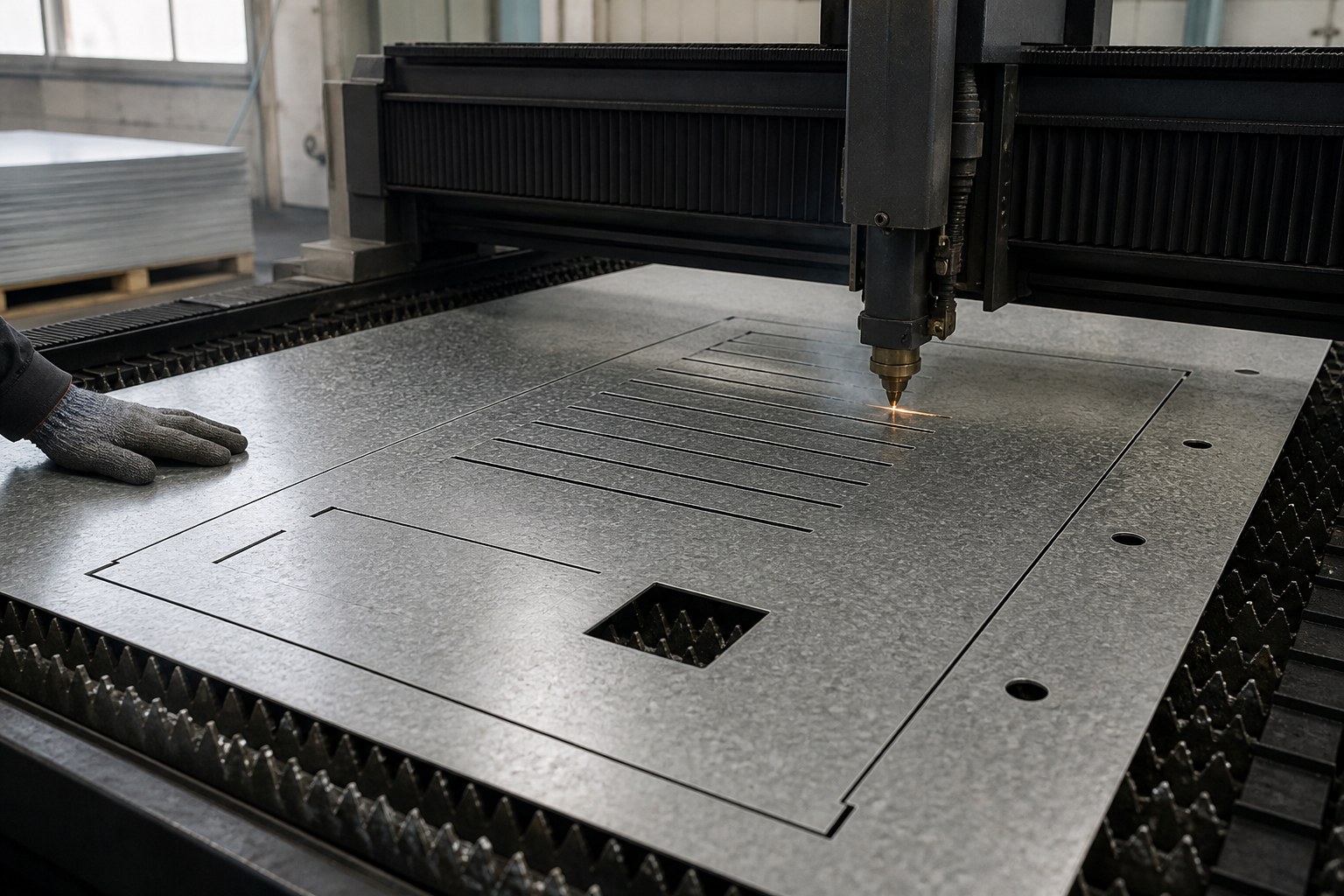
Panels were cut on our 12,000 W fibre laser with ±0.05 mm profile accuracy. Louvers and gland holes were cut in the flat, which is faster and more repeatable than post-cutting. The first article of each size was dimension-checked before the programme was locked.
Stage 2 — CNC Bending
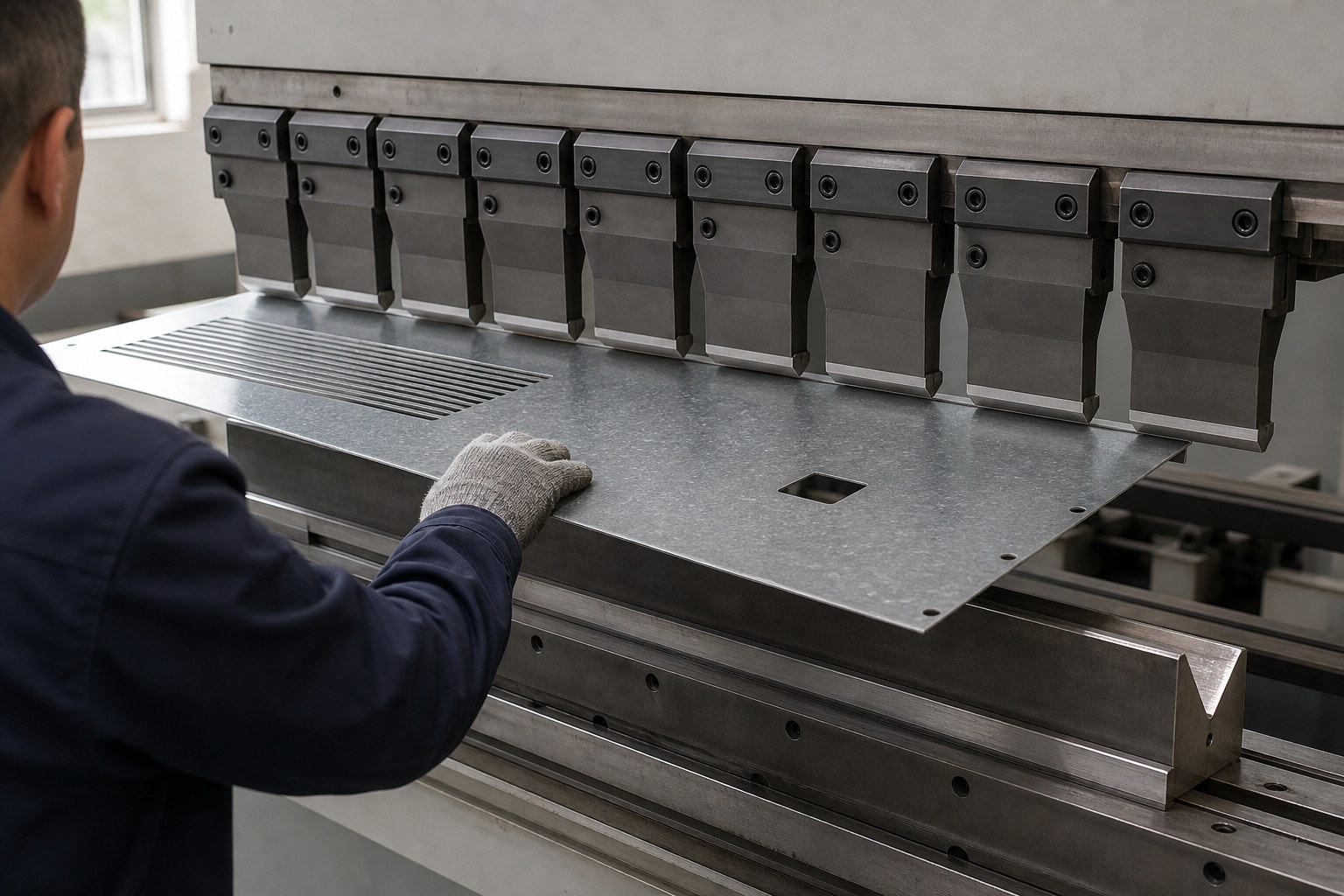
Bodies and doors were folded on a JFY TPR8-100 press brake — 100 tonnes, 3,200 mm bed, ±0.5° on angle. Door frames were formed with the gasket channel in the same operation, so the seal path is consistent along all four sides.
Stage 3 — Welding and Hardware
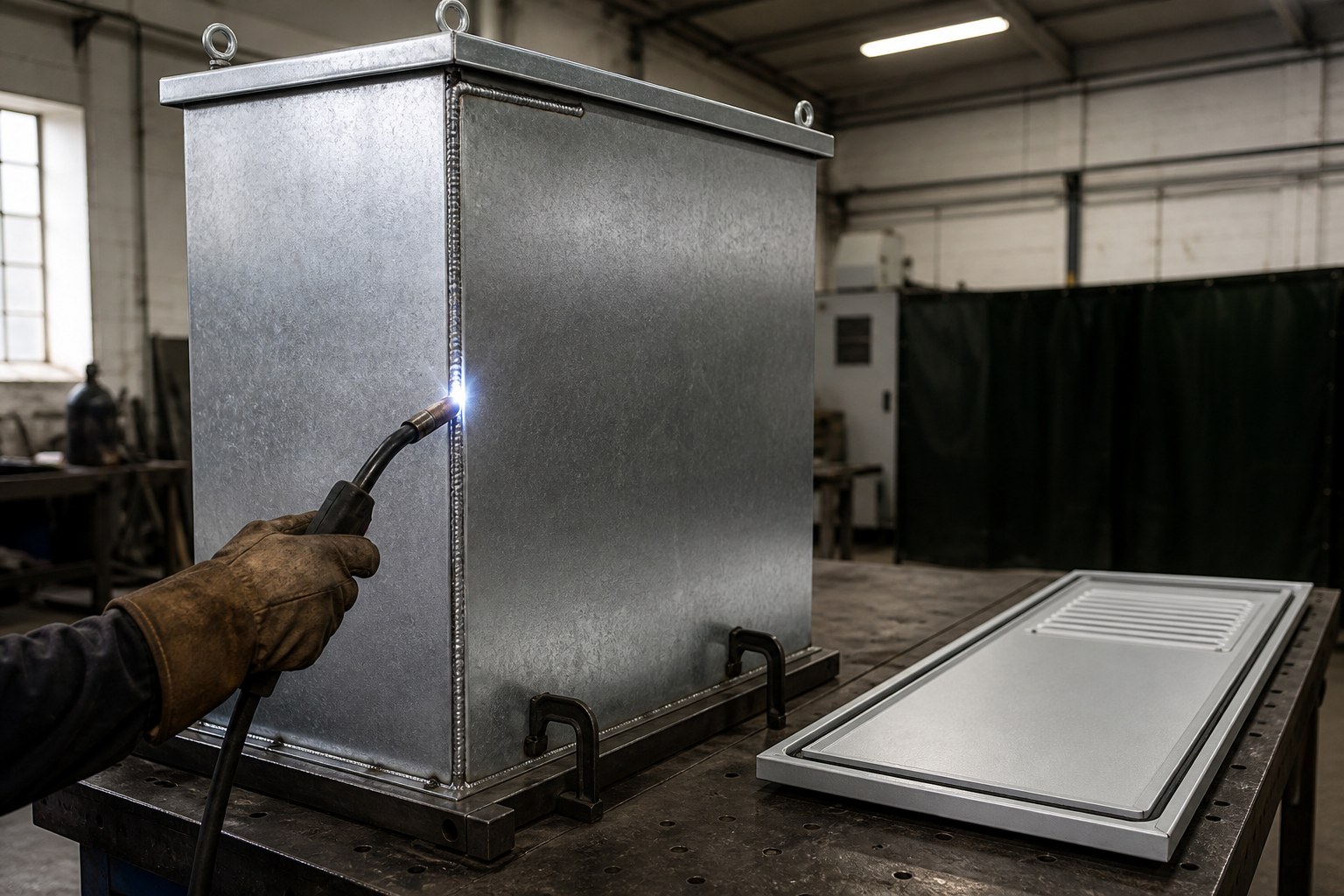
Frame sub-assemblies were MIG welded, with laser welding used on the longer seams where distortion would fight the door fit. PEM studs and weld-nuts were installed with the right tooling so internal mounting rails sit flat. All welds on weather-exposed corners were ground and inspected for pinholes.
Stage 4 — Surface Finishing
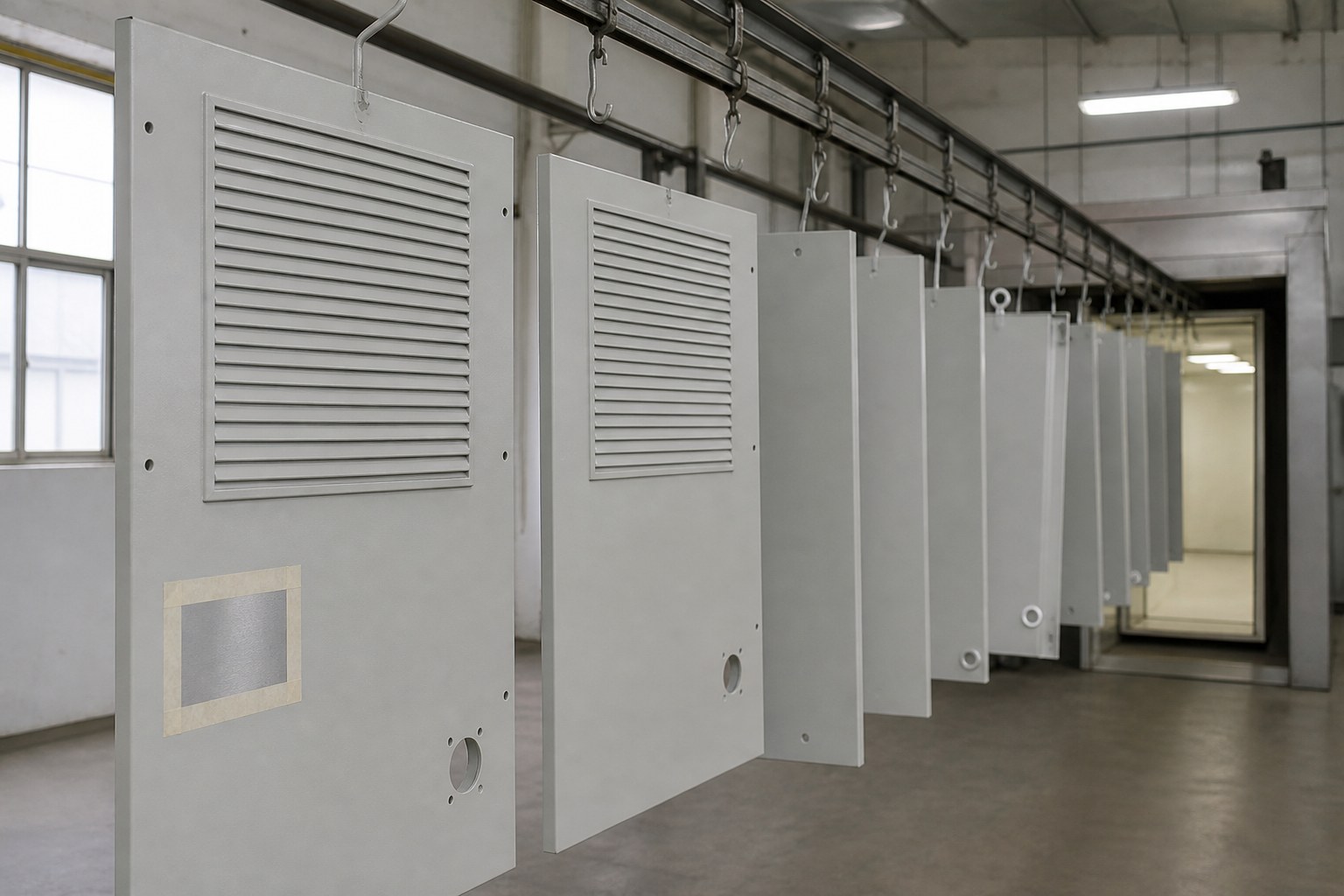
Enclosures were pre-treated, primed and powder coated with a weather-rated two-coat system over the galvanised substrate. Coating thickness was verified per batch, and the integrator received the readings with each shipment. Where the spec called for it, stainless steel variants (304 and 316L) were offered for coastal installations.
Stage 5 — Inspection and Packing
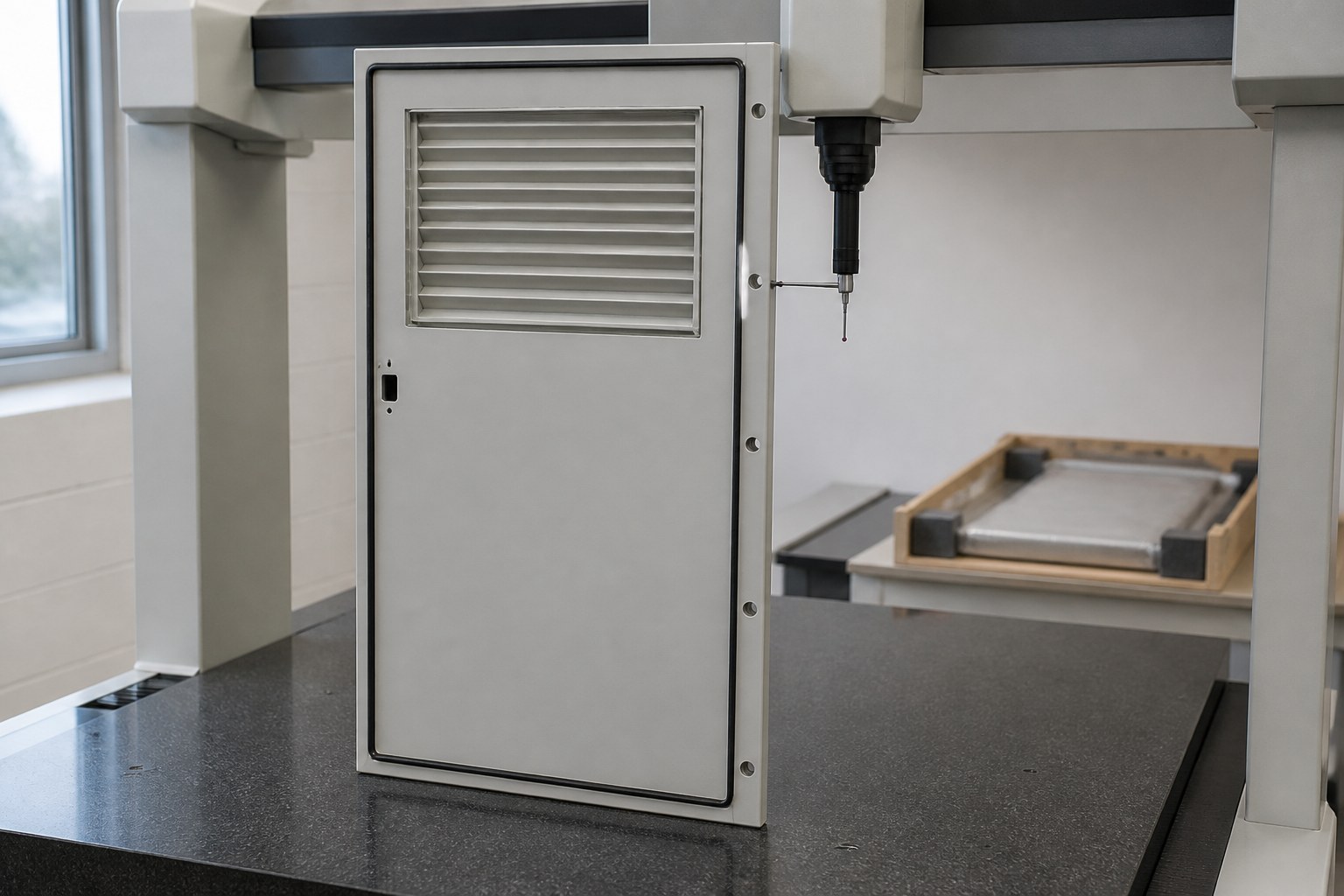
Every door frame was checked on a coordinate measuring machine for squareness and hole position — a bad door frame is the fastest way to ruin a production run downstream. Units were then wrapped, edge-protected and packed for container loading.
Why the Enclosure, Not the Cells, Decides Whether the Site Passes
An outdoor battery storage enclosure is judged on three things that have nothing to do with cell chemistry: whether water stays out, whether heat gets out, and whether the structure still holds its geometry after a decade of wind and thermal cycling. All three are set by the sheet metal.
What an IP rating actually asks of the fabricator. IP54 or IP55 is not a coating specification, it is a statement about the seal path. Water enters an enclosure at the seams, not through the panels, which makes the door frame the critical part of the build. Forming the gasket channel into the door frame in the same press-brake operation keeps the seal path continuous around all four corners instead of relying on four separate welded mitres to line up. The gasket itself is fitted after welding, so the seal never sees heat. And because a gasket only works if the frame is square, door frames are CMM-checked for squareness on every unit before finishing. A frame a millimetre out of square will still accept a gasket — it just will not seal evenly, and that is the failure that appears two rainy seasons later.
Ventilation and thermal path. Louvers and gland plates are cut in the flat, before forming, because a louver cut into a flat panel is repeatable to ±0.05 mm while the same feature added after bending is not. Position matters as much as shape: louvers sitting behind internal racking move almost no air, and cable glands that clash with a mounting rail force a site modification. Both are checked against the racking layout before the programme is released rather than discovered at commissioning.
Corrosion protection over a galvanised substrate. Galvanised steel protects itself at cut edges, but it is a poor substrate for powder without the right pre-treatment. The route here was pre-treat, prime and then a weather-rated two-coat system, with coating thickness read per batch and the readings shipped with the units. For coastal installations the specification moves to 304 or 316L stainless instead. That decision is usually driven by chloride exposure and expected service life, and it is worth making on the drawing rather than after the first corrosion report.
Quality Control
- ISO 9001:2015 quality records, registration 34025Q30296R0S, verifiable at the CNCA registry
- CMM reports for door-frame squareness and mounting-hole positions
- EN 10204 material certificates for galvanised and stainless supply
- Coating thickness readings per batch, with salt-spray notes where requested
Project Parameters at a Glance
The figures behind the three-size programme:
| Parameter | Specification |
|---|---|
| Enclosure sizes | Approximately 1,400 × 1,000 × 2,200 mm; 1,000 × 800 × 2,000 mm; 800 × 600 × 1,800 mm |
| Material | Galvanised steel, 1.5 mm and 2.0 mm; 304 or 316L stainless for coastal service |
| Sealing | Gasket-channel formed door frames with continuous foam seals, IP54 class |
| Blanking | 12,000 W fibre laser, profile accuracy ±0.05 mm; louvers and glands cut in the flat |
| Forming | JFY TPR8-100 press brake, 100 t over a 3,200 mm bed; gasket channel formed in the same operation |
| Finish | Pre-treatment, primer and weather-rated two-coat powder system over galvanised substrate |
| Inspection | CMM squareness and mounting-hole checks on every door frame |
| Documentation | EN 10204 material certificates; coating thickness readings per batch; ISO 9001:2015 (34025Q30296R0S) |
| Programme | First articles in 4 weeks across all three sizes; series scheduled to customer milestones |
| Outcome | Second and third housing suppliers folded into the XCWY programme |
The Result
| Metric | Delivered |
|---|---|
| Scope | Three enclosure sizes in one programme, sharing tooling and finish line |
| First article | Approved on first review for all three sizes |
| MOQ | From 1 pc — design validated with a single unit before series |
| Quote response | Engineering review and quotation within 3 business hours |
| Lead time | First articles in 4 weeks; series scheduled to customer milestones |
The integrator has since folded its second and third housing suppliers into the XCWY programme.
What This Means for Your BESS Enclosure Project
Outdoor storage enclosures look simple until they have to survive weather, racking and audit. What XCWY brings is a single accountable floor: laser cutting, press-brake forming, welding, hardware, finishing and CMM inspection under one roof, one quality system and one engineer.
Laser cutting
CNC bending
Welding assembly
Surface finishing
Enclosures case study
Send your BESS enclosure drawing for a 3-hour review
An engineer reviews your drawings and returns pricing plus DFM feedback within 3 business hours. MOQ from 1 pc, NDA signed on request.
FAQ
What material do you use for outdoor BESS enclosures?
Galvanised steel as standard, with stainless steel 304 or 316L options for coastal and high-humidity installations. Sheet gauges run from 0.3 mm to 6.0 mm, and material certificates (EN 10204) are available.
Can you hold IP54 / IP55 sealing on a welded enclosure?
Yes. Gasket-channel formed door frames with continuous foam seals are part of our standard fabrication route, and door fit is CMM-checked on every unit before finishing.
What is the largest enclosure you can build?
With a 3,200 mm press-brake bed and 12,000 W laser, we fabricate enclosures up to roughly 3,000 mm in the bending direction. Tell us your size on the drawing and we will confirm the route.
Do you build enclosures in multiple sizes for one programme?
Yes — this case study covered three sizes sharing one tooling and finish line, which keeps per-unit cost down for the whole family.
What is your minimum order and lead time?
MOQ from 1 pc for validation; first articles typically 4 weeks from drawing approval, with series production scheduled to your milestones. Quotations are returned within 3 business hours of receiving the drawing.
Should the enclosure be galvanised or stainless for an outdoor site?
Galvanised steel with a weather-rated powder system is the default for inland and moderate-humidity sites. Move to 304 or 316L stainless where the installation sees salt spray, industrial chloride or regular wash-down. The extra material cost is usually smaller than the cost of a corrosion repair on an installed unit.
How do you stop louvers from being blocked by internal racking?
Louvers and gland plates are laid out against the racking drawing before the laser programme is released. Because they are cut in the flat, repositioning them at that stage costs nothing; discovering the clash at commissioning costs a site modification.
What documentation ships with a BESS enclosure batch?
Each shipment carries EN 10204 material certificates for the galvanised or stainless supply, coating thickness readings for the batch, and ISO 9001:2015 quality records under registration 34025Q30296R0S. CMM reports for door-frame squareness are available on request.
Leave a Reply