Food-Grade Stainless Steel Parts: A Hygienic Fabrication Case Study From XCWY
Hygienic fabrication is unforgiving. A weld that looks fine on a visual pass can trap product, hide bacteria and fail an audit six months later. Food processing equipment demands more than “stainless steel” — it demands weld quality, surface finish and documentation that survive scrutiny. This case study shows how we fabricated a family of food-grade stainless components at our Nanpi plant, and the inspection points that made the difference.
In short: a European food processing equipment maker ordered stainless hoppers, guards and contact parts in 304 and 316L, with ground-flush welds, brushed finishes and full EN 10204 3.1 material certificates. Every weld was checked for pinholes and sharp edges, and each batch shipped with traceable documentation under ISO 9001:2015.
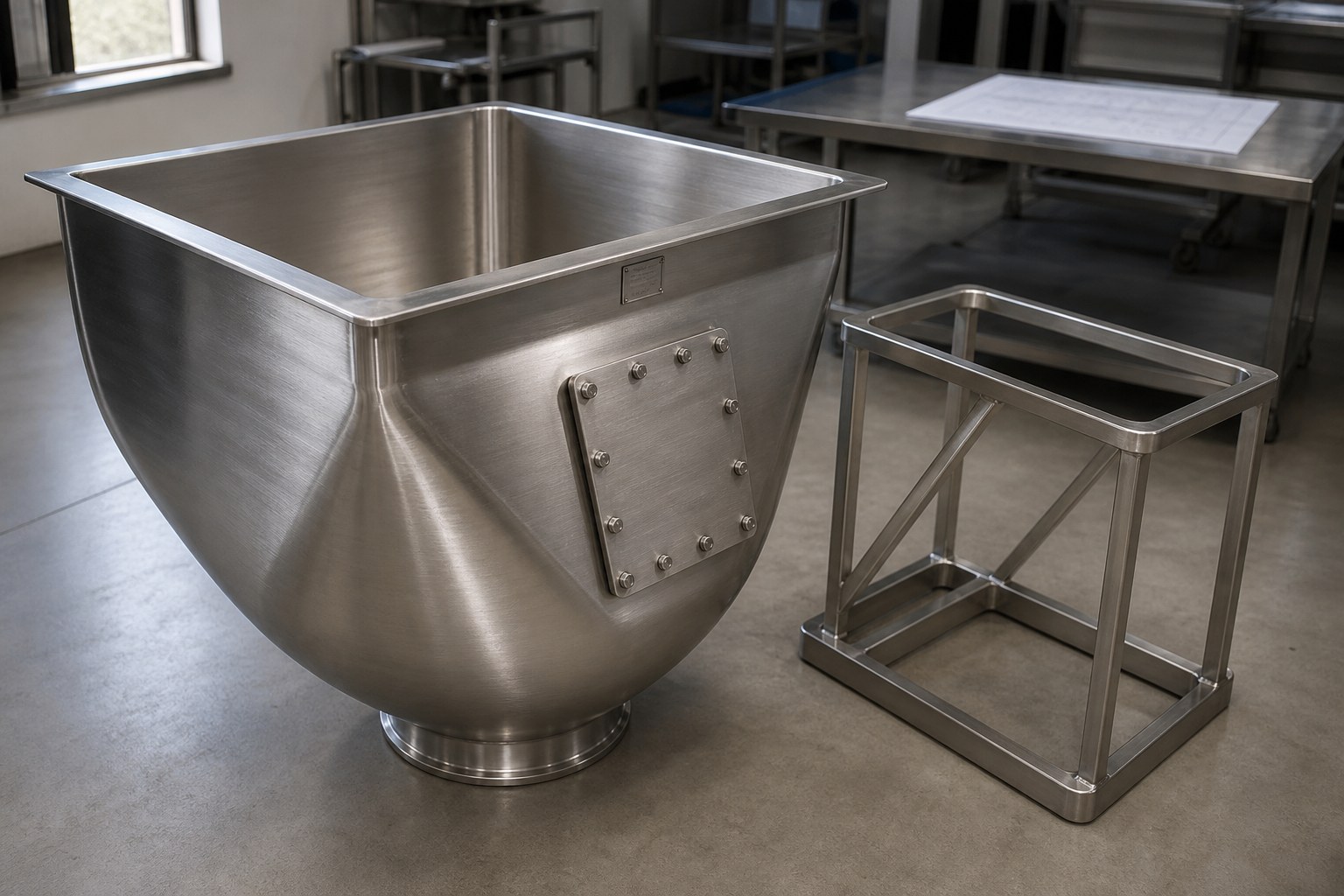
The Project
The scope covered three product families for a food processing line: a mixing hopper assembly, discharge chutes and a set of guarding frames. Materials were 304 stainless for general contact surfaces and 316L where the process ran with higher chloride exposure. What made the job demanding was not the forming — it was the hygienic rules around every weld and edge:
- Ground-flush welds on all product-contact seams — no crevices, no pits, no spatter
- Rounded and deburred edges everywhere, including the backs of parts an inspector would never see
- Brushed 240-grit finish on visible surfaces, with surface roughness verified
- Passivation after finishing to restore the corrosion-resistant oxide layer
- Full traceability: heat numbers, EN 10204 3.1 certificates and weld records for every batch
The customer had been machining these parts in-house. Outsourcing them meant trusting a supplier with both geometry and hygiene — which is exactly why documentation was written into the purchase spec, not negotiated afterwards.
How We Built It
Stage 1 — Laser Cutting
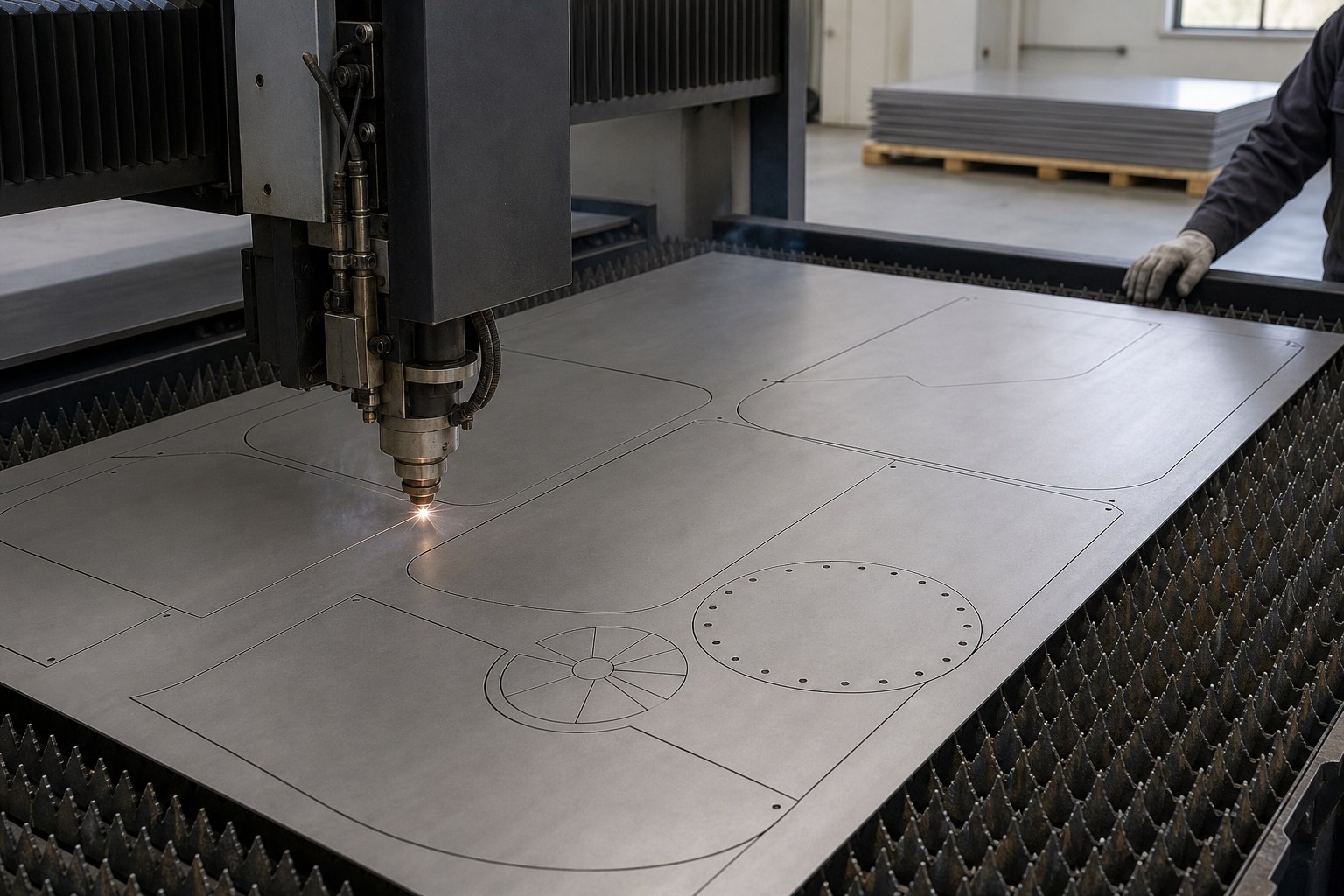
Blanks were cut on our 12,000 W fibre laser with ±0.05 mm profile accuracy. Stainless was cut with nitrogen assist to keep edges clean and oxide-free — the cut edge becomes the weld prep, so starting clean saves hours downstream.
Stage 2 — CNC Bending
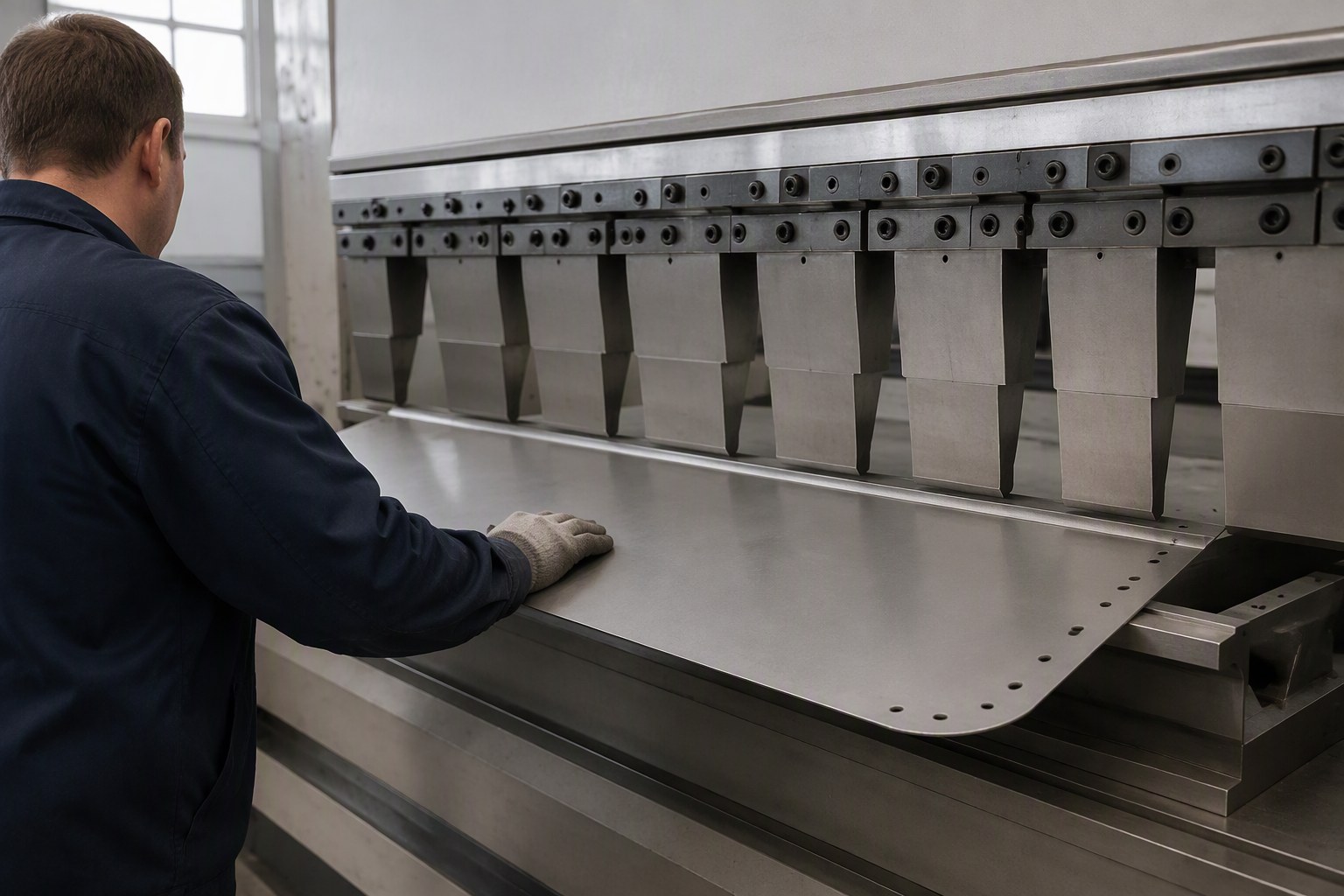
Hopper bodies and chutes were formed on a JFY TPR8-100 press brake — 100 tonnes, 3,200 mm bed, ±0.5° on angle. Internal radii were specified for cleanability, and the flat patterns were developed so the formed parts close with consistent gaps ready for welding.
Stage 3 — Welding
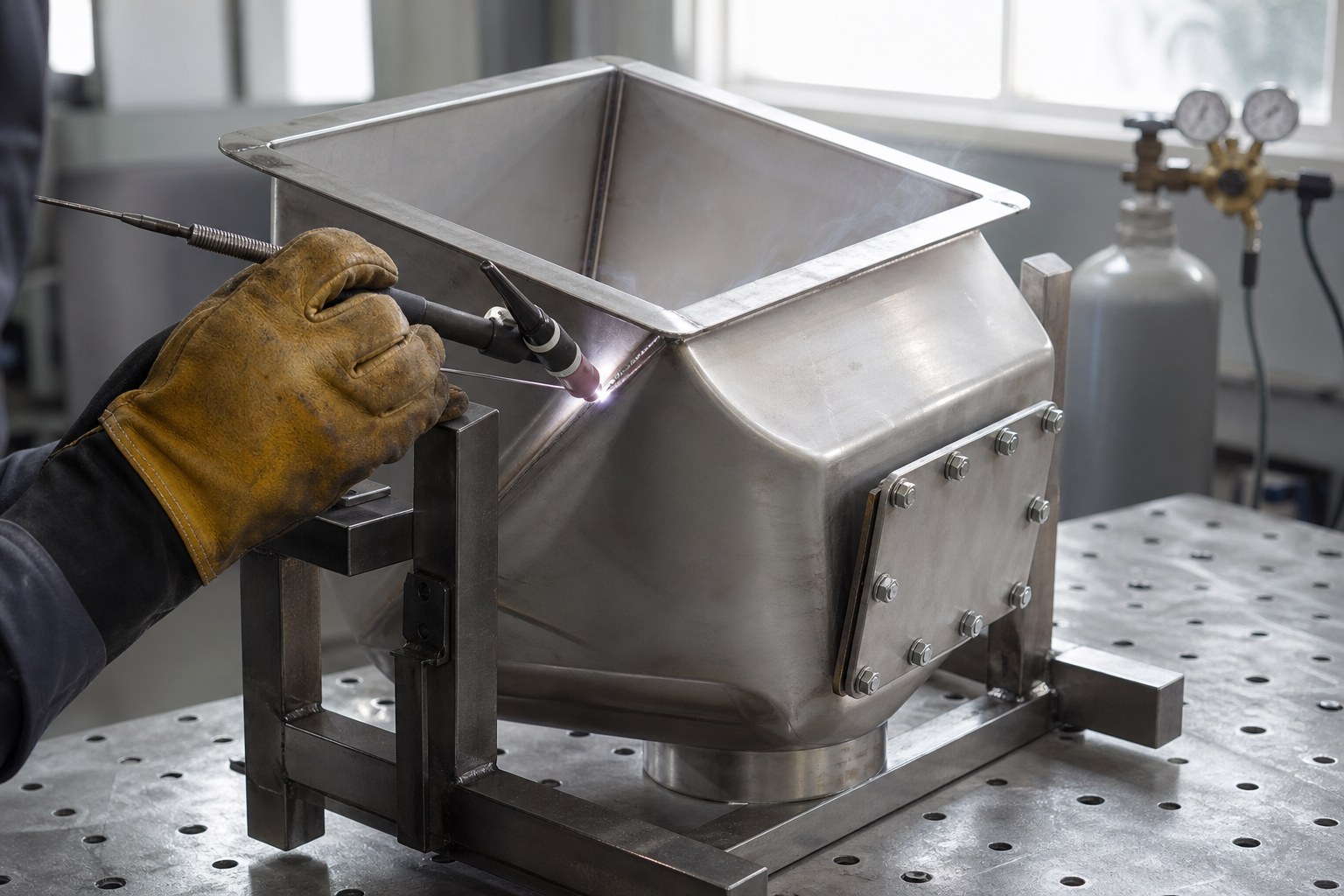
Product-contact seams were TIG welded with controlled heat input to limit distortion and discolouration, then ground flush and blended so no crevice remains. Frame and guard welds were MIG where hygiene class did not require the same treatment. Every weld was individually inspected for pinholes, undercut and sharp edges before finishing.
Stage 4 — Surface Finishing
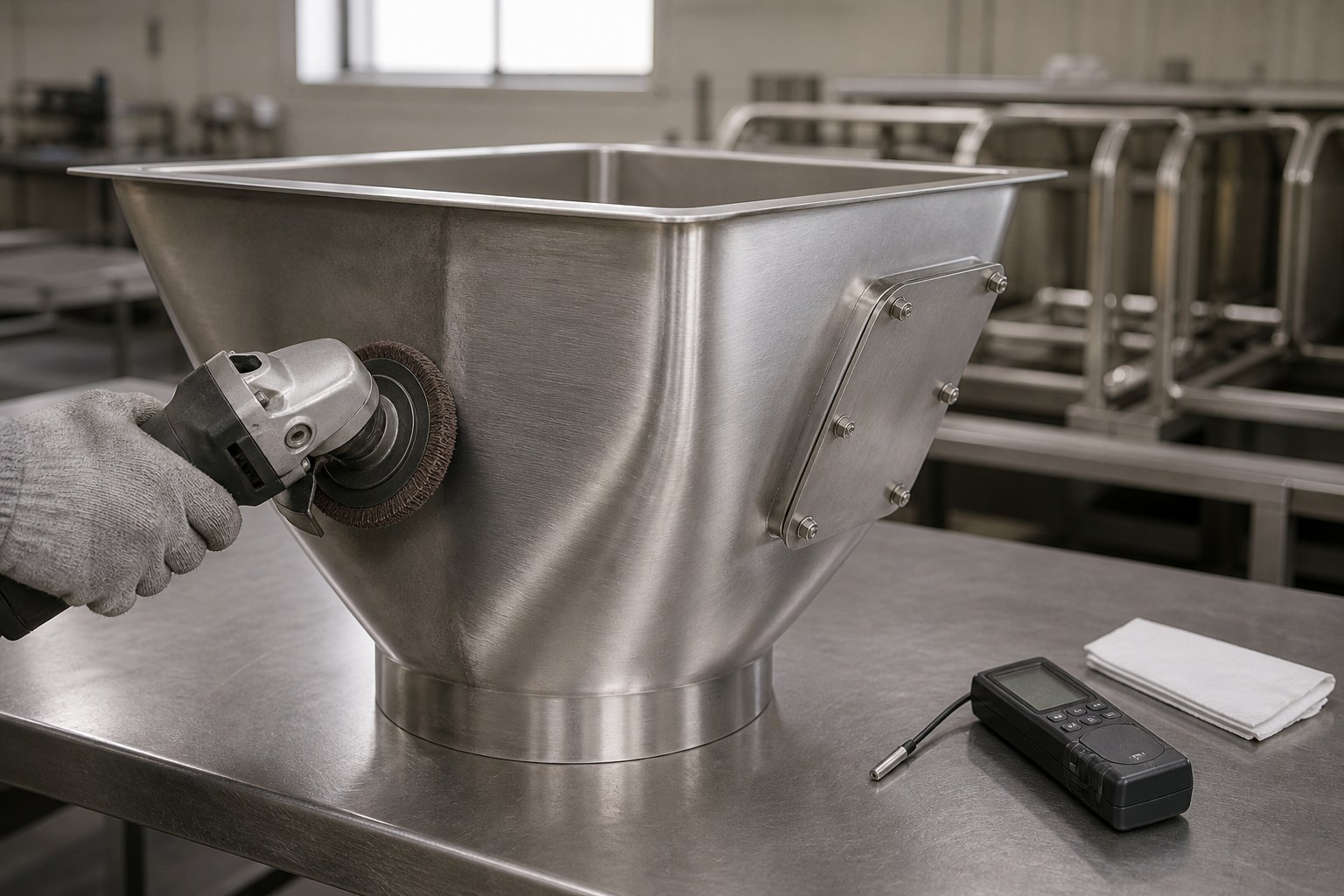
Visible surfaces were brushed to a 240-grit finish with roughness checked on a profilometer. Contact parts were then passivated — a step too many fabricators skip, and the one that actually gives stainless its corrosion resistance. See our surface finishing page for the full range.
Stage 5 — Inspection and Documentation
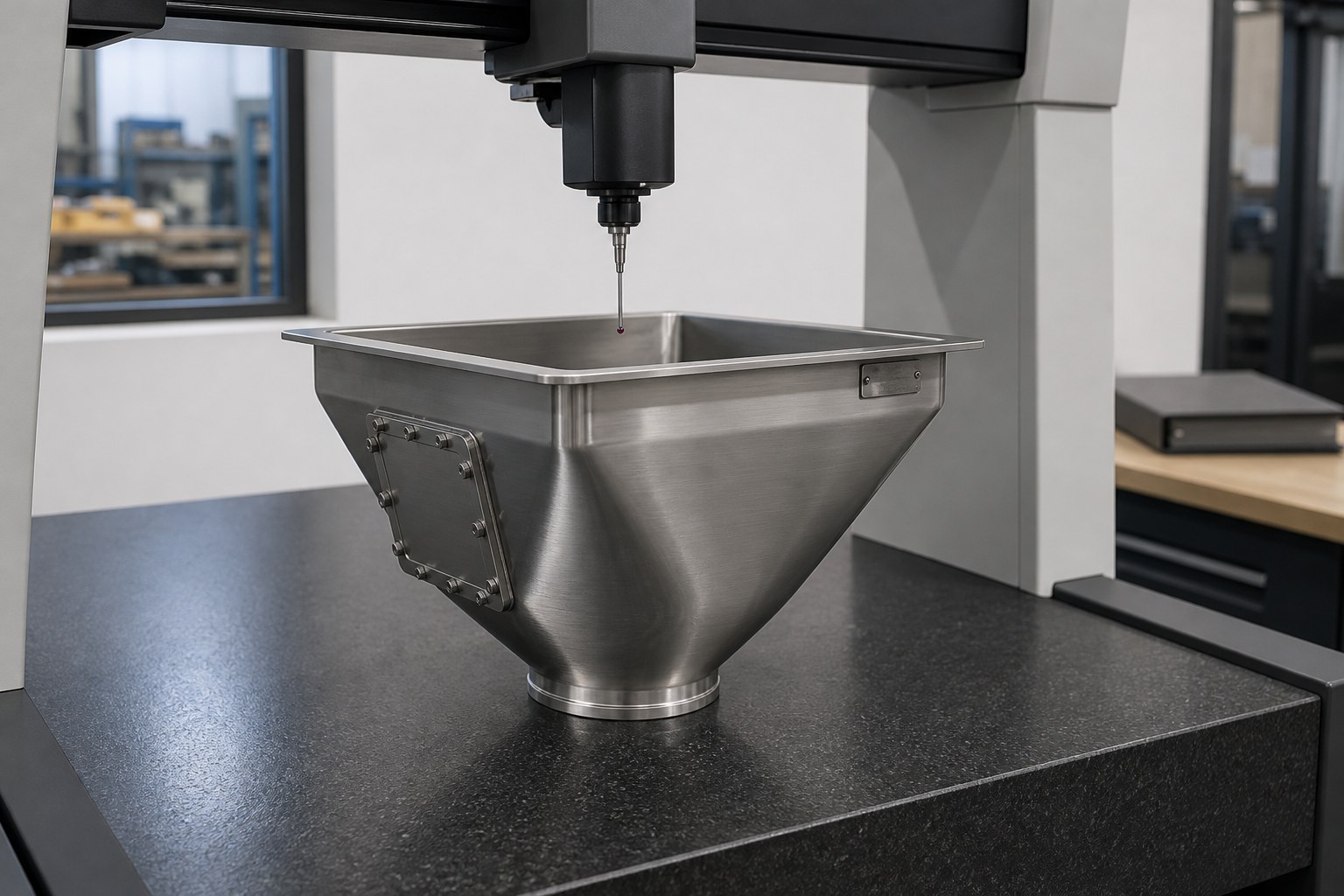
Geometry was checked on the coordinate measuring machine; welds and finish were inspected visually and by dye-penetrant where the spec required it. Each batch shipped with EN 10204 3.1 certificates, heat numbers and the inspection record — the paper trail the customer’s own auditor wants to see.
Why “Stainless” Is Not the Same as Hygienic
A 304 sheet with a rough weld is not food-grade equipment. The material resists corrosion; it does not by itself create a surface a cleaning regime can actually clear. Three things decide whether a part passes a hygiene audit, and all three are set during fabrication rather than ordered from the mill.
Crevices, not bacteria, are the real enemy. Audits fail on geometry, not on material certificates. Product and cleaning fluid collect wherever there is a gap, a pit or an undercut: the underside of a weld toe, a tight internal corner, the back of a joint an inspector never sees. That is why product-contact seams are TIG welded with controlled heat input and then dressed flush and blended, rather than welded and left proud. The weld has to be continuous and crevice-free along its full length, including where it wraps a corner, because one undercut section is enough to trap material and start a contamination pocket.
Radii and drainage. Hygienic design is largely about making sure nothing can sit still. Internal corners are given a generous radius rather than a tight bend so a cleaning tool or a wash cycle can reach the whole surface, and hoppers and chutes are formed so product drains completely instead of pooling in a flat area. Forming those radii on a press brake with the flat patterns developed in-house keeps the welded joints consistent, which matters because an uneven gap at the seam is exactly what produces an uneven weld.
Finish and passivation. Visible surfaces are brushed to a 240-grit finish with roughness verified on a profilometer, because a measurable figure is something an auditor can accept and an impression is not. Passivation follows. After welding and grinding, the chromium oxide layer that gives stainless its corrosion resistance is depleted in the heat-affected zone; passivating restores it. It is the step most often skipped by fabricators working to a price, and it is the one that shows up later as early pitting on a customer line.
Quality Control
- ISO 9001:2015 quality records, registration 34025Q30296R0S, verifiable at the CNCA registry
- EN 10204 3.1 material certificates with heat numbers for 304 and 316L supply
- Weld inspection: pinhole, undercut and edge checks on every product-contact seam
- Surface roughness readings and passivation verification on finished parts
Project Parameters at a Glance
The route behind the three product families:
| Parameter | Specification |
|---|---|
| Product families | Mixing hopper assembly, discharge chutes, guarding frames |
| Material | 304 stainless for general food contact; 316L where chloride or acid exposure is higher |
| Blanking | 12,000 W fibre laser, nitrogen assist, ±0.05 mm profile accuracy, oxide-free cut edges |
| Forming | JFY TPR8-100 press brake, 100 t over a 3,200 mm bed, ±0.5° on angle |
| Product-contact welds | TIG with controlled heat input, ground flush and blended; no crevice, pit or undercut |
| Frame and guard welds | MIG, where the hygiene class does not require flush dressing |
| Finish | Brushed 240-grit visible surfaces, roughness verified on a profilometer |
| Passivation | Standard step after welding and grinding, not an optional extra |
| Documentation | EN 10204 3.1 certificates, heat numbers, weld inspection records, ISO 9001:2015 (34025Q30296R0S) |
| Programme | Three product families; tank components added to the same route afterwards |
The Result
| Metric | Delivered |
|---|---|
| Product families | Three — hoppers, chutes and guarding, on one accountable floor |
| Documentation | Complete before shipment — auditor signed off from the file |
| MOQ | From 1 pc — first hopper validated before the full line committed |
| Quote response | Engineering review and quotation within 3 business hours |
| Repeat programme | Customer added tank components to the same route |
What This Means for Your Food-Grade Project
Hygienic fabrication is won in the details — weld prep, surface finish, passivation and the paper that proves all three. That is exactly what XCWY does on one floor under one quality system.
Material selection guide
Welding assembly capability
BESS enclosure case study
Send your food-grade drawings for a 3-hour review
An engineer reviews your drawings and returns pricing plus DFM feedback within 3 business hours. MOQ from 1 pc, NDA signed on request.
FAQ
Which stainless steel do you use for food contact?
304 as standard for general food contact, 316L where the process sees higher chloride or acid exposure. Both are supplied with EN 10204 3.1 certificates and heat-number traceability.
How do you make welds hygienic?
Product-contact seams are TIG welded with controlled heat input, ground flush and blended so no crevice, pit or undercut remains. Weld quality is inspected on every seam before finishing.
What surface finish can you achieve?
Brushed finishes from 240 to 400 grit, with surface roughness verified by profilometer. Polished finishes are available on request for specific applications.
Do you passivate stainless after finishing?
Yes. Passivation restores the chromium oxide layer after welding and grinding — it is a standard step in our food-grade route, not an optional extra.
What documentation do you provide?
EN 10204 3.1 material certificates, heat numbers, weld inspection records and ISO 9001:2015 quality documentation — the file your auditor wants, complete before shipment.
Can you match parts the customer currently machines in-house?
Yes. We work from the drawing or from supplied samples, agree the datum and the inspection method, and validate the first part before the programme is released. Documentation is written into the specification from the start rather than negotiated at shipment.
How do you verify a weld is crevice-free?
Every product-contact seam is inspected individually for pinholes, undercut and sharp edges before finishing, and dye-penetrant inspection is added where the specification requires it. The check is recorded against the batch, so the weld record and the material certificate travel together.
What surface roughness can you hold?
Brushed finishes from 240 to 400 grit, with roughness verified by profilometer rather than assessed visually. Polished finishes are available on request where an application calls for a lower Ra. Tell us the target Ra on the drawing and we will confirm it in the first-article report.
Leave a Reply