A reliable battery energy storage system enclosure is not made weather-resistant by one component. Its performance depends on the complete interface between the door, frame, gasket, latches, hinges, cable entries, ventilation system and fabricated sheet-metal structure.
An IP-rated latch alone does not make a BESS enclosure IP66. The assembled enclosure must maintain the required protection at every seam and penetration, and any final IP or NEMA claim should be supported by the test requirements agreed for the project.
What Is a BESS Enclosure?
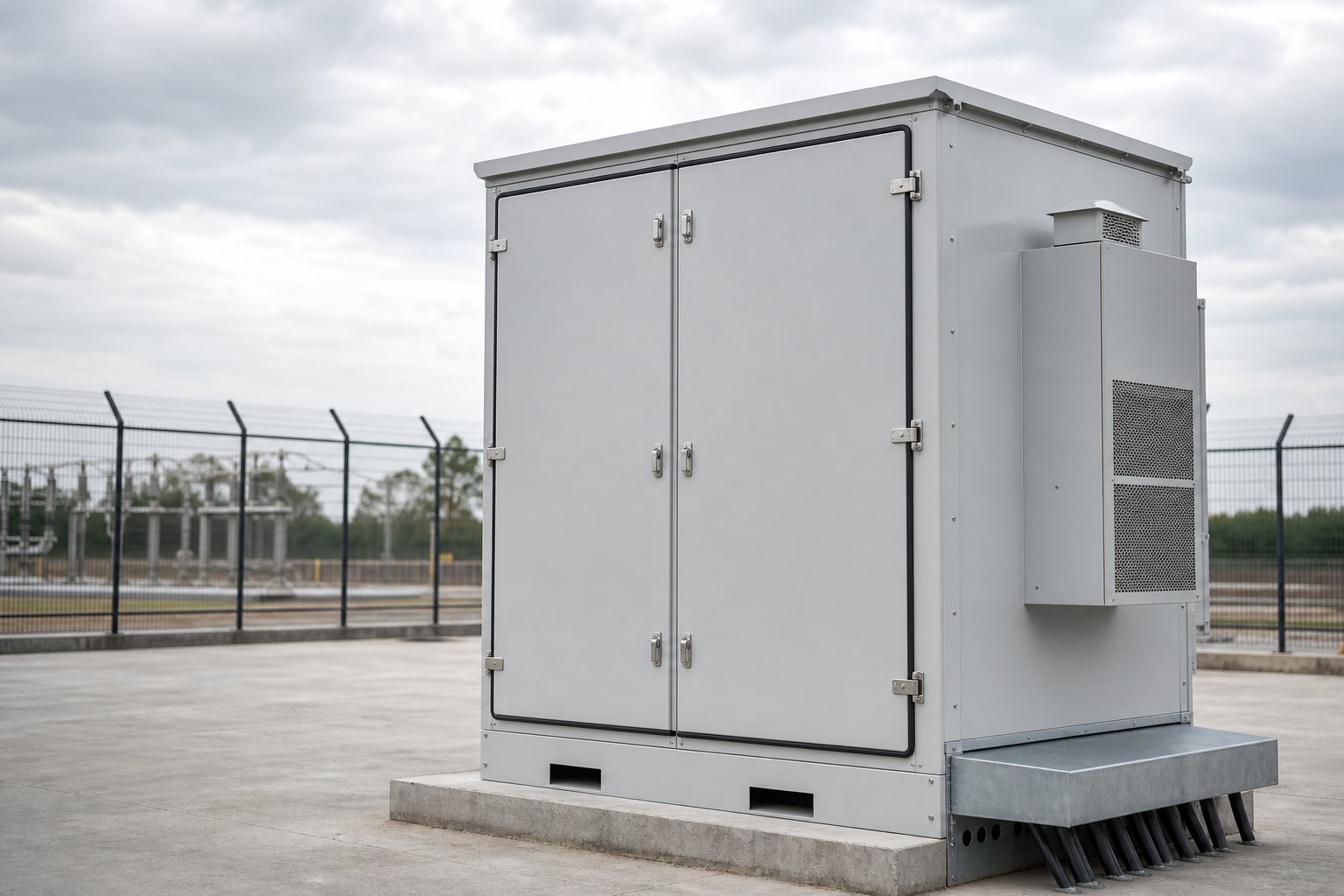
A BESS enclosure protects the batteries, electrical components, control hardware and related systems used in a battery energy storage installation. Depending on the project, the enclosure may be a compact cabinet, a larger equipment housing or part of a containerized system.
The enclosure normally has to support several functions at the same time:
- limit the ingress of dust and water;
- provide controlled access for inspection and maintenance;
- support cable entries, electrical interfaces and internal equipment;
- resist transportation, installation and service loads;
- manage heat, condensation and environmental exposure;
- maintain door alignment and gasket compression over repeated use;
- provide corrosion protection appropriate to the installation environment.
These requirements interact. Increasing sealing can make thermal management more difficult. A large door can improve maintenance access but may flex and lose uniform gasket compression. A heavy coating system can improve corrosion resistance but change hinge, latch and clearance dimensions. Good BESS enclosure design therefore starts with the operating environment and system interfaces, not with a generic cabinet drawing.
What IP Rating Does a BESS Enclosure Need?
The required ingress-protection level depends on where the enclosure will be installed, how it will be exposed and what the customer or applicable project specification requires.
The IP Code defined in IEC 60529 classifies protection against access to hazardous parts and the ingress of solid objects and water. The first numeral addresses solid-object protection; the second addresses water protection. The rating is a property of the tested enclosure assembly, not a material, coating or individual latch.
| Installation condition | Main exposure to evaluate | Design focus |
|---|---|---|
| Controlled indoor area | Dust, accidental contact and limited dripping | Door gaps, penetrations, maintenance access and internal separation |
| Sheltered outdoor area | Wind-driven rain, temperature cycling and condensation | Gasket continuity, drip edges, drainage and corrosion protection |
| Exposed outdoor area | Dust, heavy rain and water jets | Door stiffness, continuous sealing, multi-point compression and sealed penetrations |
| Coastal or corrosive environment | Salt, moisture, coating damage and galvanic interaction | Base material, coating system, fastener compatibility and drainage |
| Hot or cold climate | Thermal cycling, gasket ageing and condensation | Seal material, ventilation or cooling interfaces, pressure and moisture management |
A manufacturer should not select a final protection rating from the enclosure shape alone. The correct starting information includes the installation location, direction of water exposure, expected dust, temperature range, maintenance frequency, cable-entry arrangement, cooling method and the test standard specified by the buyer.
For the official definition of IP ratings, see the IEC explanation of ingress protection.
IP55 vs IP66 for BESS Enclosures
IP55 and IP66 are sometimes treated as interchangeable marketing labels, but they represent different protection expectations. A project team should use the exact IEC definitions and test conditions rather than relying on a simplified conversion chart.
| Design question | Lower sealing demand | Higher sealing demand |
|---|---|---|
| Water exposure | Limited or controlled exposure | Stronger outdoor water exposure specified by the project |
| Door construction | Fewer compression points may be acceptable | Door stiffness and distributed compression become more important |
| Gasket path | Continuous and controlled | Continuous, controlled and more sensitive to local gaps |
| Penetrations | Sealed to the project requirement | Every cable, vent and service opening becomes a critical interface |
| Thermal strategy | Natural or filtered ventilation may be possible | Sealed heat exchange or other controlled thermal methods may be required |
| Verification | Inspection plus agreed testing | More demanding assembly control and project-specified testing |
A higher IP target is not automatically a better design. Greater sealing can increase hardware cost, assembly sensitivity and thermal-management complexity. The right requirement is the one that protects the equipment in its real environment without creating unnecessary cost or heat-management risk.
NEMA enclosure types cover environmental conditions differently from IEC IP codes and should not be treated as exact one-to-one equivalents. For North American projects, review the official NEMA enclosure type information together with the customer specification.
How Latches, Hinges and Gaskets Work Together
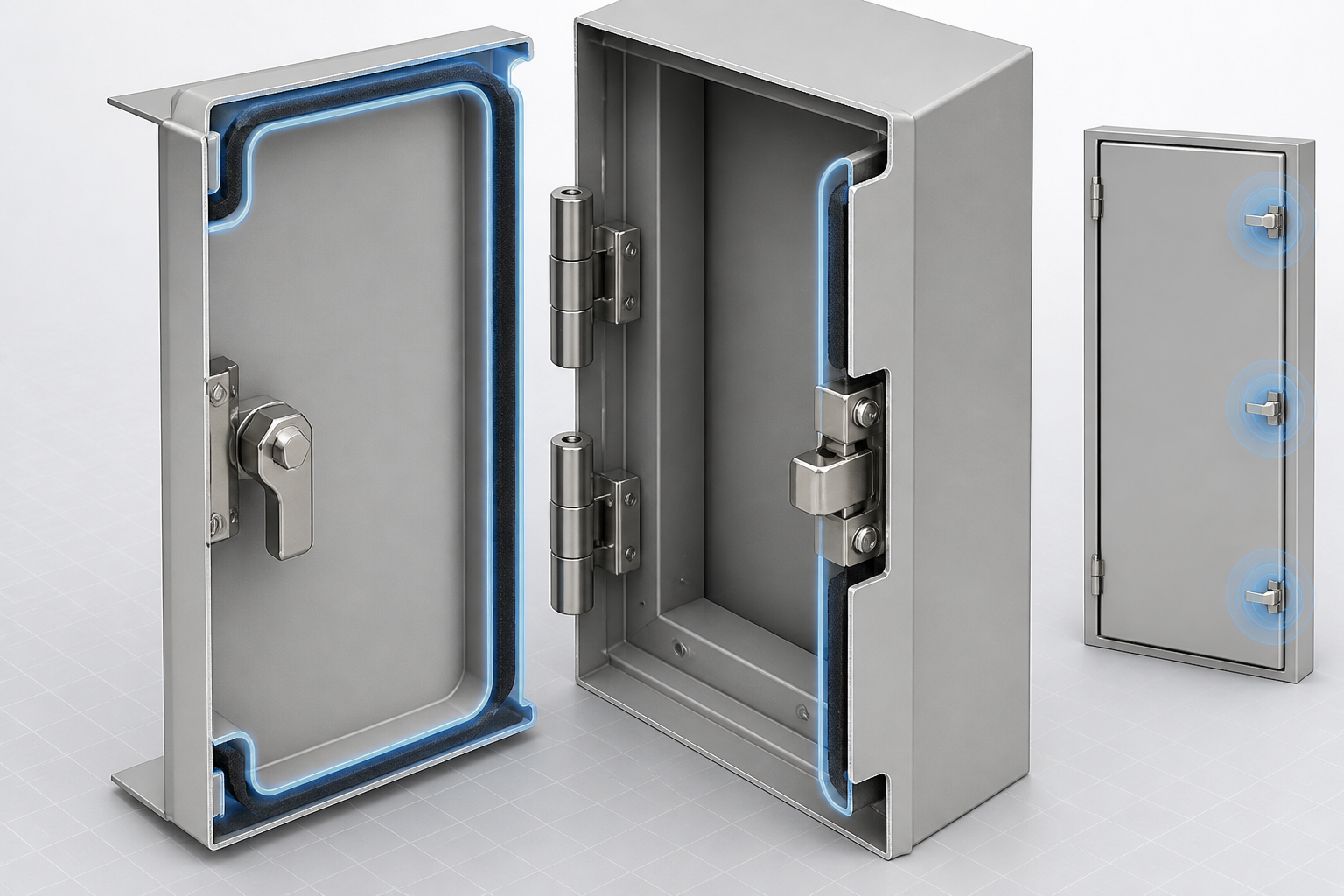
The door-sealing system works as one mechanical assembly. If the door bends, the hinge drops or the latch pulls unevenly, the gasket may be compressed in one area and loose in another.
Compression Latches
A compression latch pulls the door toward the frame during the final part of its closing motion. This can help apply repeatable pressure to the gasket and reduce rattling or local gaps.
Latch selection should consider:
- required grip range;
- door and frame thickness;
- gasket section and compression limits;
- required operating force;
- corrosion environment;
- locking and access requirements;
- internal clearance;
- service life and adjustment needs.
A component supplier may state that a latch is suitable for an IP-rated system, but that statement does not certify the complete cabinet. Door flatness, frame geometry, gasket joints and penetrations still control the assembled result.
Multi-Point Latching
A tall or wide door may deflect between two isolated latch points. Multi-point latching or several coordinated compression latches can distribute pressure along the perimeter and reduce local loss of gasket contact.
The number and spacing of latch points should follow door size, panel stiffness, gasket behavior and test requirements. Adding more hardware without controlling the door structure does not guarantee better sealing.
Hinges and Alignment
The hinge establishes the door path and supports its weight. Hinge play, mounting variation or door sag can shift the gasket relative to the frame. The result may be excessive compression near the hinge and insufficient compression near the latch.
Design reviews should check:
- hinge load and door mass;
- hinge-axis alignment;
- fastener access;
- opening angle and service clearance;
- interference with the gasket path;
- adjustment and replacement requirements.
Gasket Selection
The gasket must maintain a continuous sealing path under the actual compression applied by the hardware. Selection factors include material compatibility, cross-section, compression range, compression set, temperature, ultraviolet exposure, chemicals and expected service life.
Do not apply one generic compression percentage to every gasket. Use the selected gasket supplier’s technical data and validate the assembled door under the project test conditions.
Sheet Metal DFM Rules for a Sealed BESS Cabinet
The enclosure should be reviewed as a tolerance chain. Door size, folded returns, welded frame flatness, hinge position, latch engagement, coating thickness and gasket variation all affect the final seal.
| Design issue | Possible result | DFM action |
|---|---|---|
| Large unsupported door span | Door deflection and uneven sealing | Add returns or stiffeners and distribute latch points |
| Discontinuous sealing flange | Local leak path | Keep the gasket land continuous and control weld distortion |
| Openings close to a door seam | Short ingress path and difficult sealing | Reposition penetrations or use suitable sealed interfaces |
| Unbalanced hinge and latch layout | Door twist or uneven compression | Design hinge and latch positions as one system |
| Welds crossing the gasket land | Flatness variation and surface interruption | Move welds where possible or define post-weld finishing and inspection |
| Coating build-up at interfaces | Changed grip range and closing force | Include coating thickness in the clearance and hardware stack-up |
| No drainage or condensation strategy | Water accumulation inside the enclosure | Add controlled drainage or condensation management without defeating protection goals |
| High sealing target without a thermal plan | Excess internal temperature | Coordinate enclosure sealing with cooling, heat exchange or controlled ventilation |
Control Door and Frame Flatness
A soft gasket can absorb limited variation, but it should not be used to hide uncontrolled fabrication. The drawing should identify the sealing surface, critical datums and inspection method. Long welded frames may require a controlled welding sequence and post-weld correction.
Keep the Sealing Path Continuous
Corners, gasket joints, hinges and cable interfaces are common risk locations. The sealing path should be visible and traceable around the entire opening. Avoid unnecessary steps, abrupt changes or unreviewed gaps.
Protect Openings and Penetrations
Cable glands, vents, fans, heat exchangers, indicators and emergency interfaces all interrupt the enclosure wall. Each opening should be treated as part of the protection system and coordinated with the relevant component specification.
Design for Assembly Repeatability
A prototype may seal correctly while a production batch does not if latch adjustment, gasket placement or door alignment depends on operator judgment. Use locating features, controlled hardware, documented assembly settings and inspection checkpoints where repeatability matters.
Material and Finish Selection
Material choice should be based on environment, structural needs, fabrication route, weight and lifecycle cost.
Powder-Coated Carbon Steel
Carbon steel provides good stiffness and cost efficiency. A suitable pretreatment and coating system is important for outdoor durability, especially at edges, welds, fastener holes and damaged areas.
Galvanized Steel
Galvanized sheet provides a protective zinc layer and may suit certain enclosure structures. Cutting, welding and forming can affect local protection, so exposed edges and welded areas need appropriate treatment.
Stainless Steel
Stainless steel may be selected for corrosive, hygienic or demanding outdoor environments. Grade selection, surface finish, weld treatment and contamination control should match the application. Stainless steel does not by itself create an IP-rated enclosure.
Aluminum
Aluminum reduces weight and offers useful corrosion resistance, but lower stiffness affects large door panels. Alloy selection, joining, galvanic compatibility and coating requirements must be reviewed as part of the design.
Sealing and Thermal Management Must Be Designed Together
Battery and power-electronics systems generate heat. A highly sealed enclosure can limit natural air exchange, while open ventilation can reduce ingress protection.
The engineering team should define the thermal path early:
- passive conduction through the cabinet structure;
- controlled ventilation;
- filtered air movement;
- air-to-air heat exchange;
- liquid or refrigerant-based cooling interfaces;
- insulation and condensation control.
The enclosure fabricator needs the location, size, mounting details and sealing requirements for each thermal component. Thermal openings added after the sheet-metal design is frozen can create avoidable rework and protection risks.
Manufacturing and Inspection Workflow
A practical BESS enclosure fabrication workflow should include the following steps:
- Review the environment and protection requirement. Confirm indoor or outdoor use, dust, water, temperature and corrosion exposure.
- Review CAD and access requirements. Check overall size, door openings, maintenance zones, lifting features and equipment interfaces.
- Confirm material and finish. Match strength, corrosion resistance, weight and coating requirements.
- Review sealing interfaces. Evaluate the frame flange, door stiffness, hinge axis, latch points, gasket path and penetrations together.
- Plan fabrication. Define cutting, bending, welding, hardware insertion, surface treatment and assembly sequence.
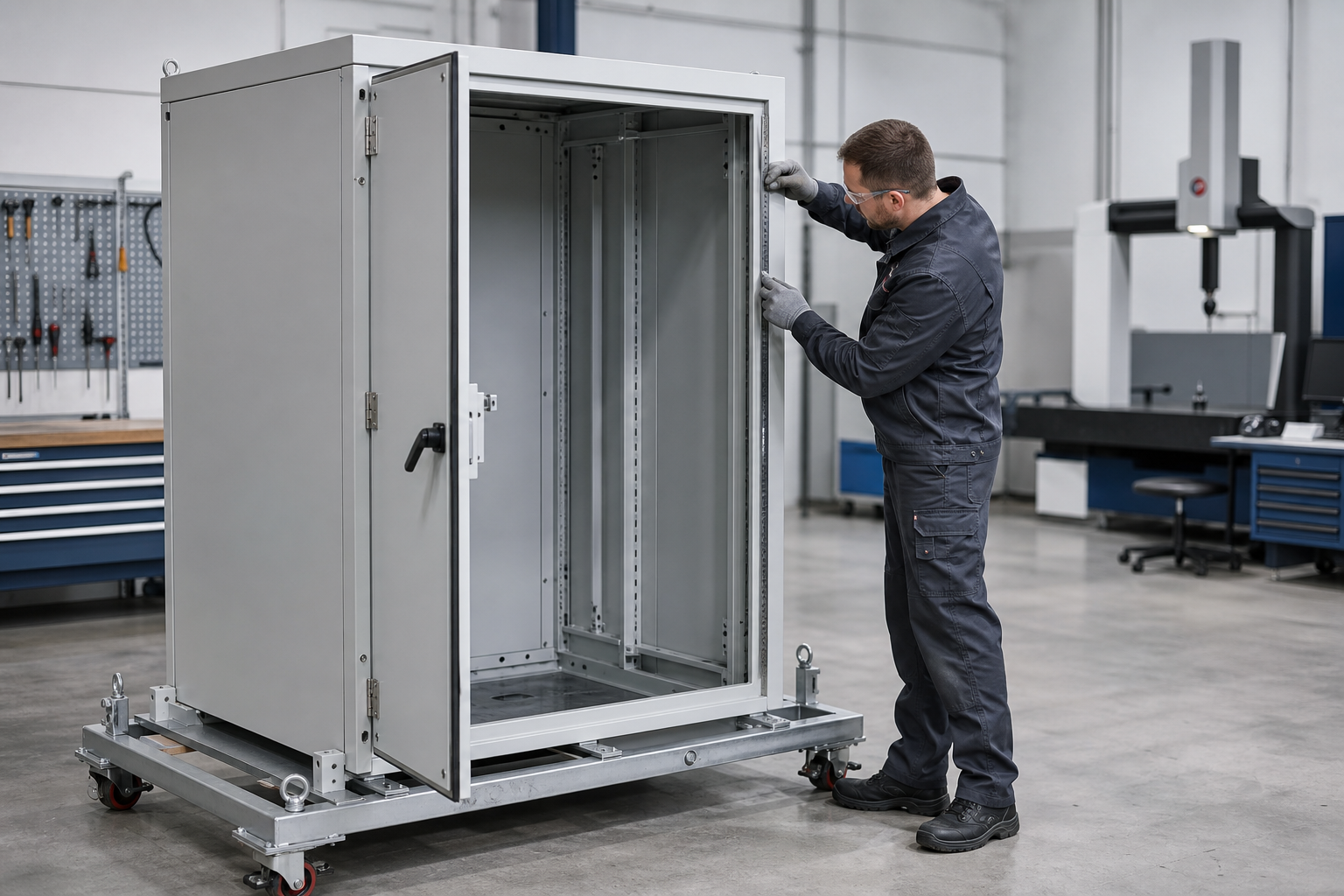
- Inspect the first article. Measure critical dimensions, flatness, alignment and hardware engagement before volume production.
- Verify gasket compression consistency. Check the complete perimeter rather than one convenient point.
- Complete project-required testing. Conduct agreed ingress, leak or environmental testing using the required standard and configuration.
- Retain revision and inspection evidence. Keep the approved drawing, bill of materials, hardware settings and inspection records linked to the production revision.
BESS Enclosure RFQ Checklist
A technically complete RFQ helps the fabricator identify risks before pricing and tooling decisions are fixed. Include:
- installation location and expected exposure;
- required IP or NEMA designation and applicable test standard;
- overall dimensions and door-opening requirements;
- internal equipment layout, weight and mounting loads;
- lifting, anchoring and transport requirements;
- preferred material and coating system;
- corrosion category or salt exposure where applicable;
- gasket and enclosure-hardware requirements;
- cable entries and all other wall penetrations;
- ventilation, heat exchanger or cooling interfaces;
- prototype quantity, production batch and expected annual volume;
- critical dimensions, datums and inspection requirements;
- required documentation and test evidence;
- matching 3D model, controlled 2D drawing and revision level.
For a broader manufacturing review, see XCWY’s energy storage metal parts, custom metal enclosures, sheet metal fabrication and quality control pages.
Frequently Asked Questions
Can an IP66 latch make the whole BESS enclosure IP66?
No. A latch can contribute to consistent gasket compression, but the complete enclosure—including the door, frame, gasket, hinges, fasteners, cable entries, vents and other penetrations—must meet the agreed protection test.
Is a multi-point latch always necessary?
No. The requirement depends on door size, stiffness, gasket behavior and the target protection level. A small rigid door may need fewer latch points; a tall flexible door may need distributed compression.
What causes water ingress around enclosure doors?
Typical causes include an interrupted gasket path, insufficient or uneven compression, door deflection, hinge misalignment, coating build-up, weld distortion, damaged gaskets and poorly sealed penetrations near the opening.
Should every outdoor BESS enclosure use stainless steel?
No. Stainless steel is one option. Properly specified coated carbon steel, galvanized steel or aluminum may also be suitable depending on corrosion exposure, structural needs, weight, cost and maintenance requirements.
How do sealing and thermal management conflict?
Greater sealing limits uncontrolled air exchange, while ventilation creates openings that must be managed. The thermal method and protection requirement should therefore be selected together, not by separate teams after the cabinet design is complete.
What files are needed for a BESS enclosure fabrication quote?
Provide a 3D model, revision-controlled 2D drawing, material and finish, target quantity, installation environment, protection requirement, hardware preference, thermal interfaces and inspection requirements.
Can XCWY review a prototype before volume production?
XCWY supports drawing review and first-article inspection as part of its sheet-metal manufacturing process. Prototype scope, test requirements and documentation should be agreed in the RFQ before production begins.
Send Your BESS Enclosure Drawing for a DFM Review
Send the enclosure drawing, installation environment, requested IP or NEMA requirement, material, quantity, hardware preference and thermal-management interfaces. XCWY can review the door flange, panel stiffness, latch positions, gasket path, penetrations and fabrication sequence before quoting.
Request a manufacturing review or email xcwystamping@xcwybj.com with the drawing revision and project requirements.
References
- IEC: Ingress Protection ratings
- NEMA: Enclosure Types
- Sandia National Laboratories: Energy Storage Safety Codes and Standards
Engineering note: This guide is for design and sourcing preparation. The required enclosure rating, test method and regulatory obligations must be confirmed for the actual system, installation and destination market.
Leave a Reply