This case study follows a deep drawn filter housing in 316L stainless steel, formed from a 1.5 mm blank in four draw stages with an inter-stage anneal. Although the part had been in production for years, it began as a welded fabrication rather than a drawn one. Consequently, the interesting engineering is not the drawing itself — it is the sequence of decisions that made a one-piece deep drawn filter housing both possible and cheaper than the assembly it replaced.
Process: 4-stage deep draw with inter-stage annealing
Press: multi-stage hydraulic draw press
Material: 316L stainless steel, 1.5 mm blank
Finished depth: 142 mm
Tolerance held: ±0.10 mm on diameter, 0.12 mm maximum wall thinning
Documentation: wall thickness map, EN 10204 3.1 mill certificate, passivation record
Certification: ISO 9001:2015, registration 34025Q30296R0S
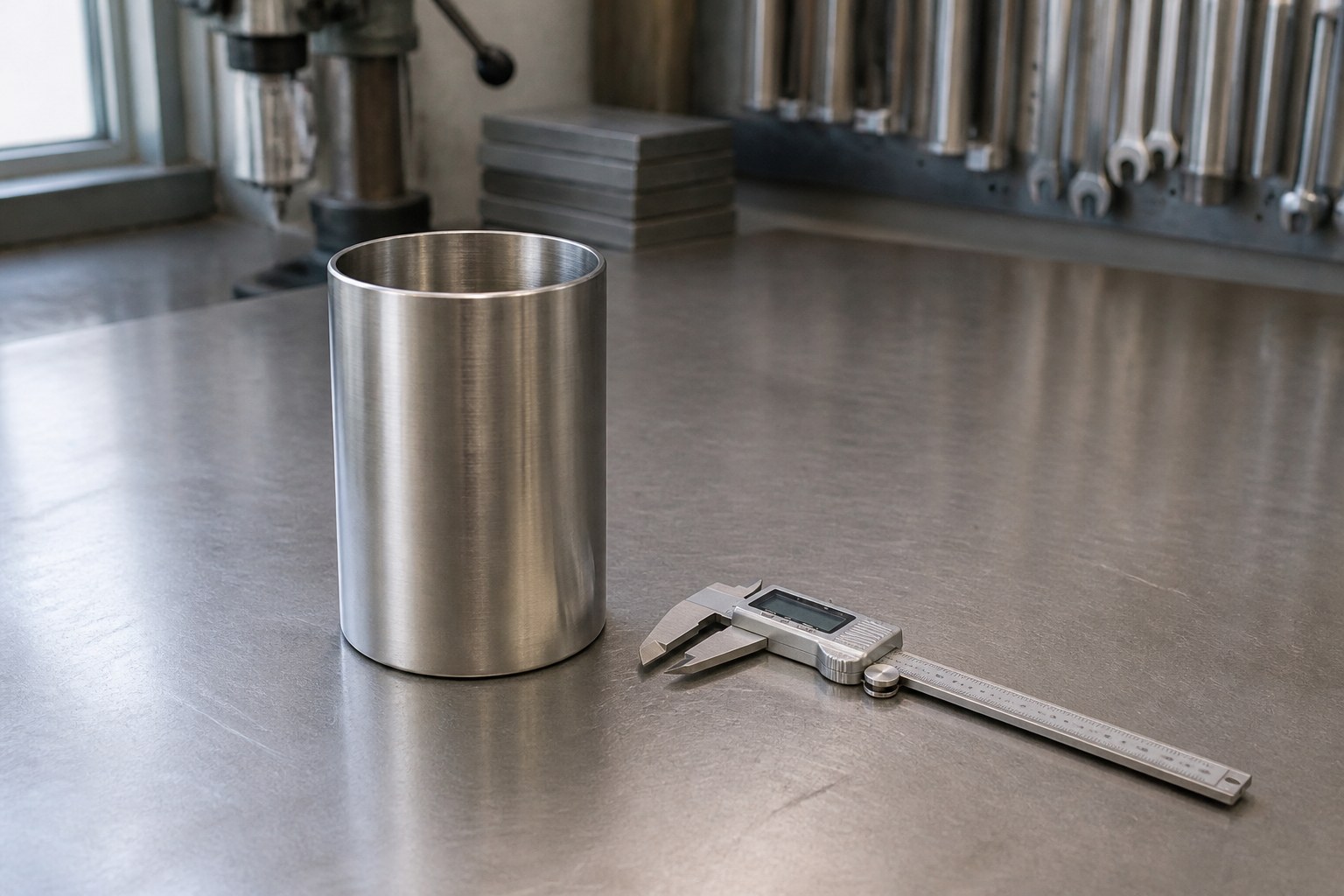
The requirement
A European process-equipment OEM needed a filter housing for a corrosive service application. Previously, the part had been produced as a welded fabrication — a drawn cup with a separately welded base and a welded fitting collar.
That approach worked; nevertheless, it carried three persistent problems:
- Weld inspection cost. Every unit needed dye penetrant inspection on the base weld, and because the reject rate was non-trivial, inspection consumed real production capacity.
- Corrosion at the weld. In 316L, the weld and its heat-affected zone are the least corrosion-resistant region of the part, regardless of post-weld passivation.
- Cosmetic rejection. Weld dressing varied between operators, so cosmetic acceptance became a judgement call rather than a specification.
Therefore, the customer asked whether the housing could be drawn in one piece instead. Because the service environment was corrosive, a one-piece deep drawn filter housing removed the weld entirely and, as a result, removed the inspection step that went with it.
Why deep drawing 316L is harder than drawing mild steel
First, three properties of 316L drive the difficulty. In addition, each of them changes the tooling and the number of stages required.
1. It work-hardens aggressively. In fact, austenitic stainless steel has a high work-hardening exponent. Because each draw stage increases the material’s yield strength, the force required for the next stage climbs. Consequently, a 316L part that would need two draws in mild steel needs three or four — with annealing between them.
2. It has a lower forming limit. However, 316L will not tolerate the draw ratios that SPCC or aluminium will. Exceeding the limit does not produce a slightly thin part; instead, it produces a torn part at the punch nose or the die entry radius. For the failure signature of each defect, see deep drawing defects and their causes.
3. It is sensitive to lubrication and die condition. For example, galling — material picking up on the die surface — is far more likely with stainless than with coated steel. Although a die may have run thousands of mild steel parts, it is not automatically ready for stainless.
Stage design for the deep drawn filter housing
In practice, the part ran in four stages from a 1.5 mm blank on a multi-stage hydraulic draw press:
| Stage | Operation | Functional purpose |
|---|---|---|
| 0 | Blank and lubricate | Blank diameter set from the draw ratio, not from the finished diameter |
| 1 | First draw to cup | Establish the cup; the deepest single reduction |
| 2 | Inter-stage anneal | Relieve work hardening before redrawing |
| 3 | Second redraw | Reduce diameter, increase depth |
| 4 | Third redraw to final diameter | Bring to near-final geometry |
| 5 | Trim, flange, pierce | Final height and hole positions after drawing is complete |
| 6 | Passivate | Restore the passive chromium oxide layer |
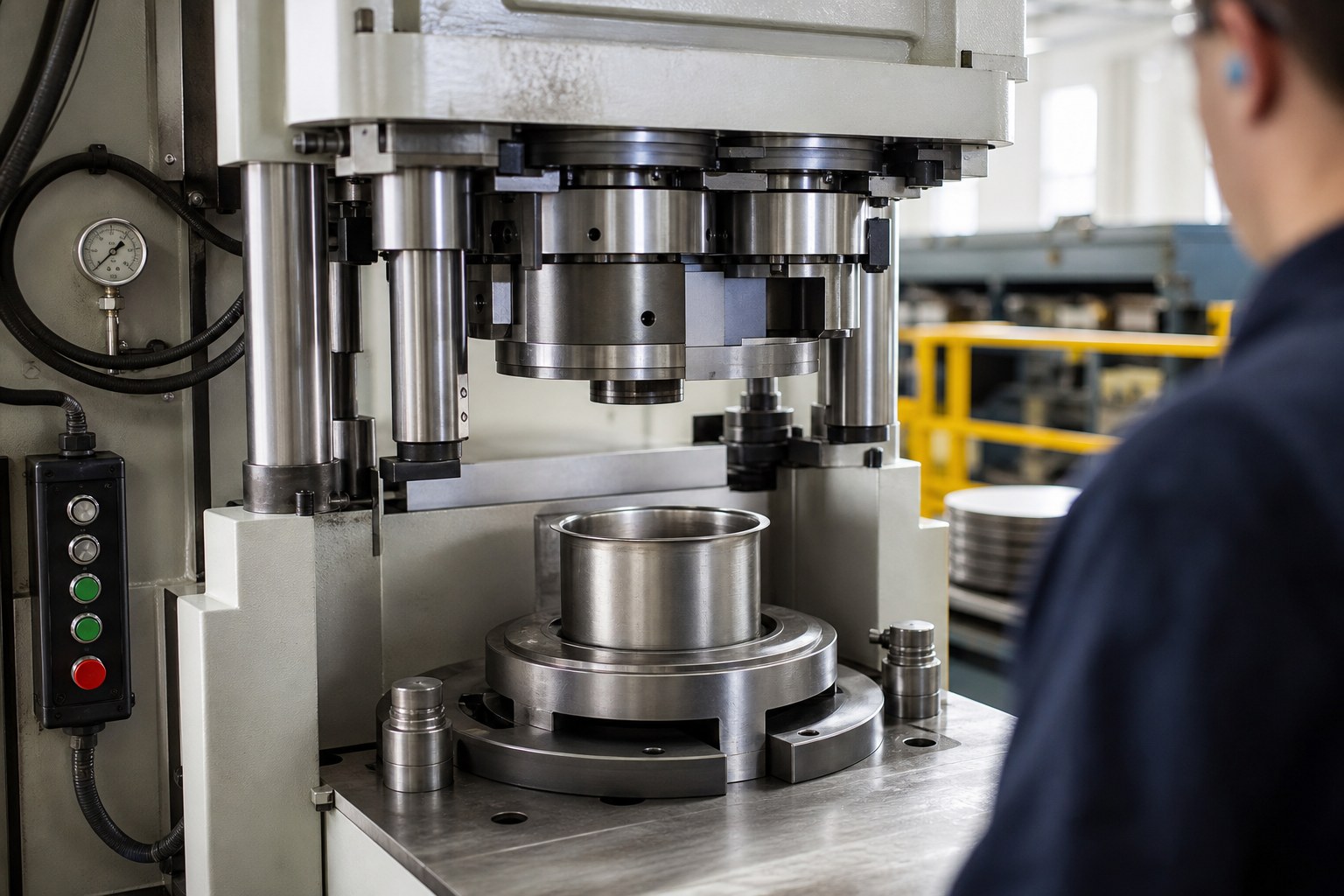
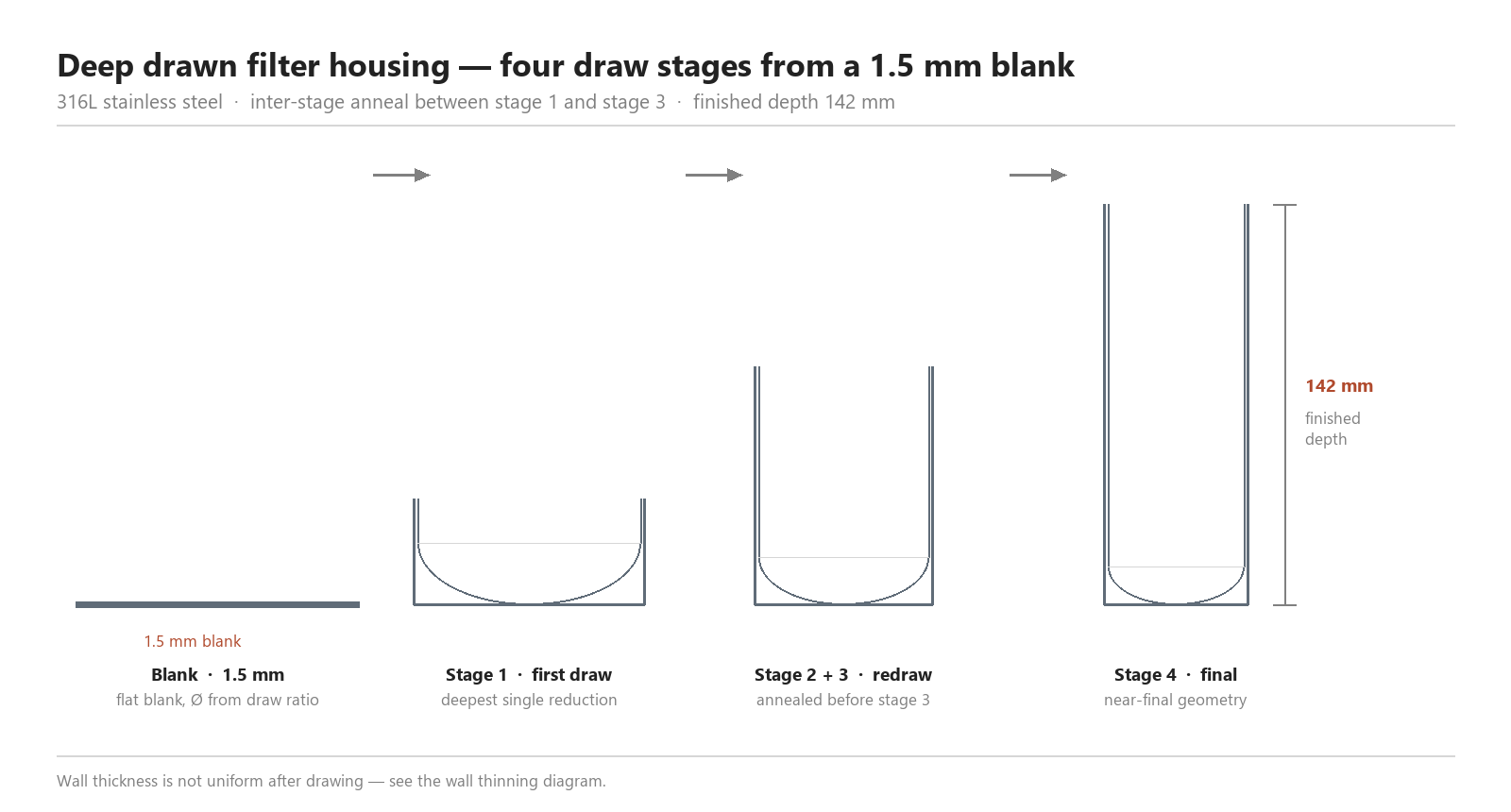
Therefore, annealing between stages 1 and 3 is what makes a 316L part at this depth possible. Skipping it and attempting to reach depth with fewer, deeper draws is, in fact, the single most common cause of tearing in stainless deep drawing. In addition, every extra draw stage adds a die and a handling step — which is precisely why shops that own a press, but not the multi-stage annealing capability, commonly outsource this process.
Wall thinning: the dimension that matters most
On any deep drawn filter housing, the wall is not uniformly 1.5 mm. Material flows from the flange into the wall during drawing, and because the flow is not evenly distributed, it thins at predictable locations:
- Punch nose radius — highest thinning
- Die entry radius — secondary thinning
- Mid-wall — slight thinning
- Base — effectively retains original thickness
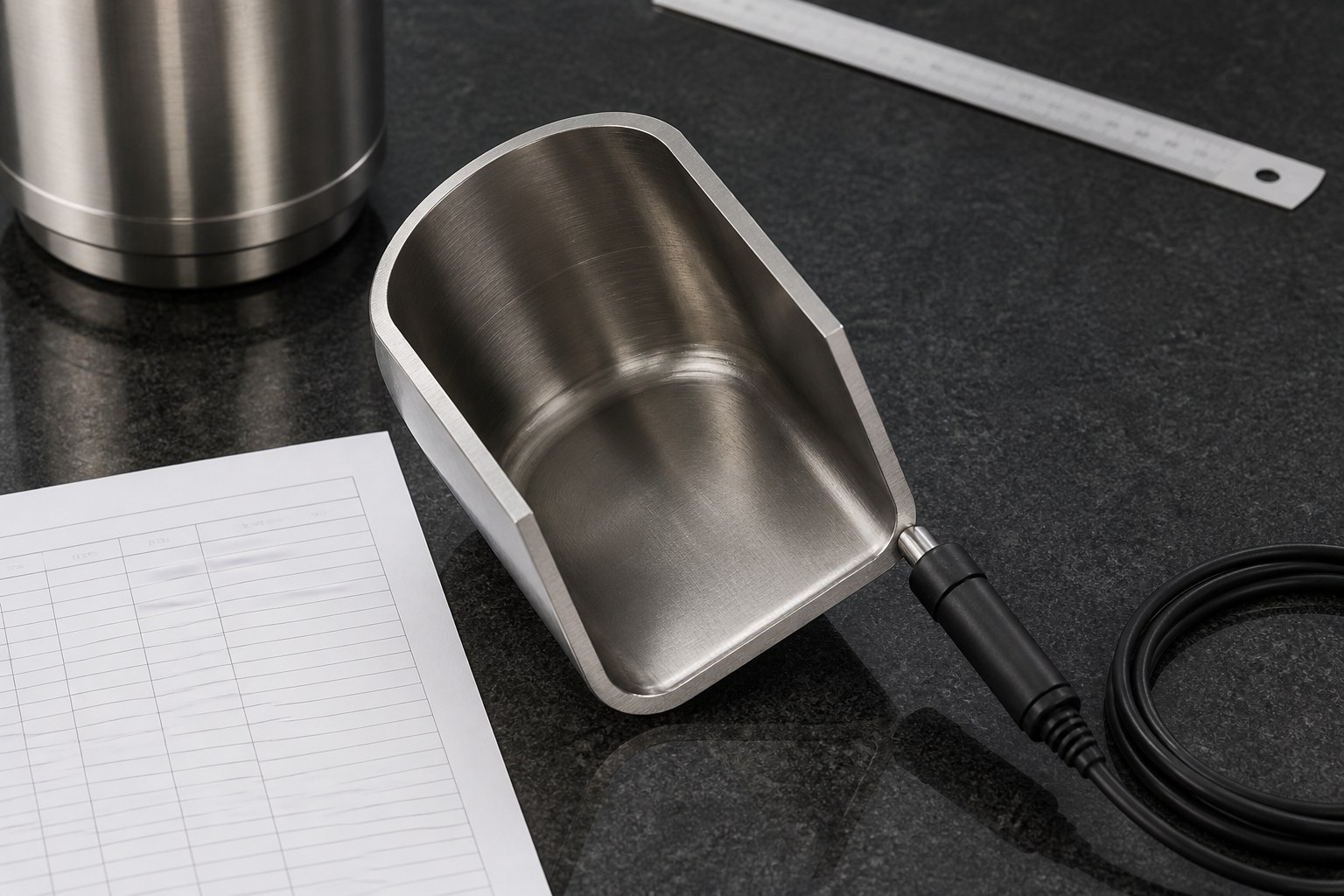
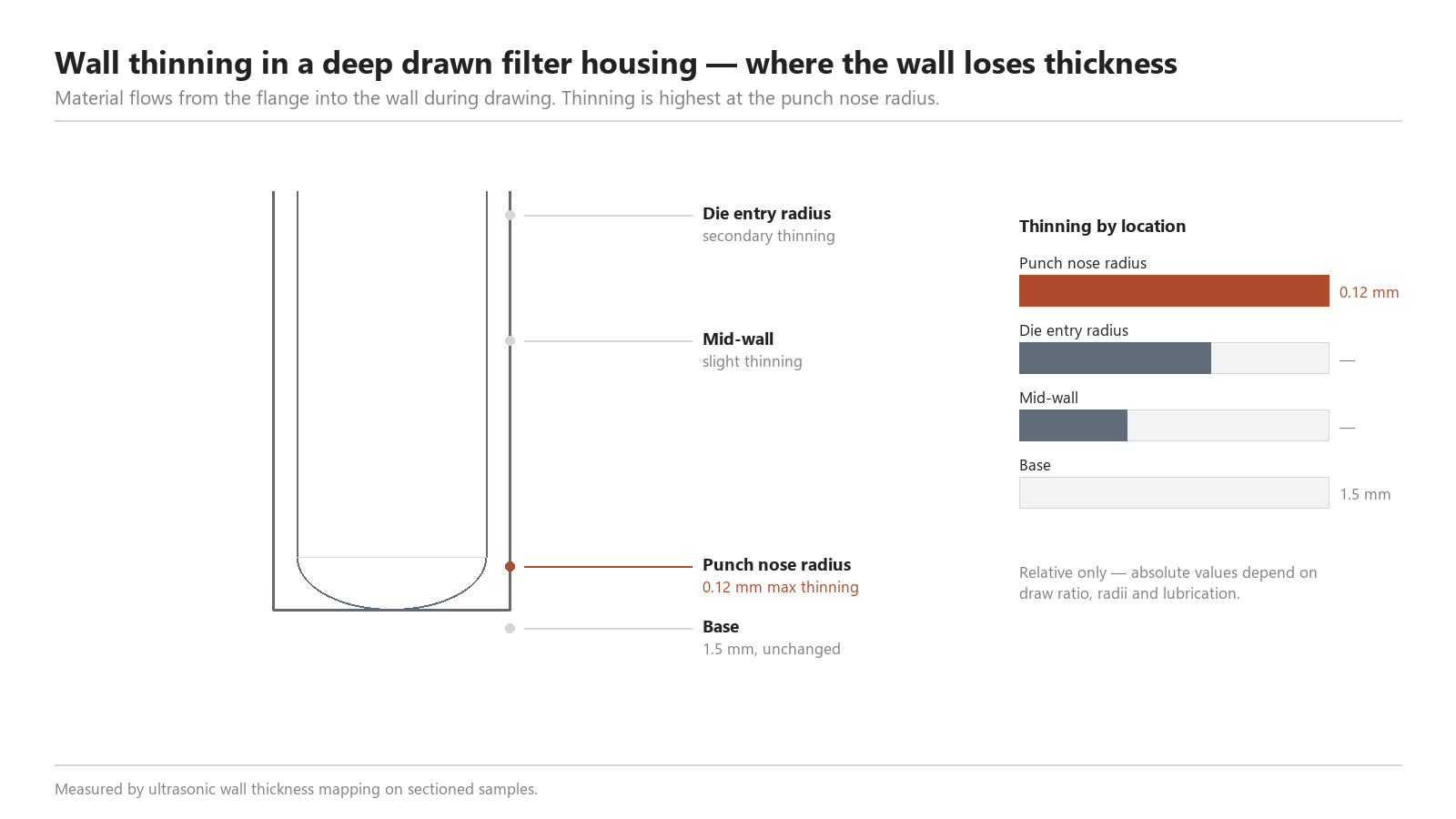
In short, thinning at the punch nose is typically the controlling dimension for whether a housing survives its service pressure. For this part the limit was 0.12 mm maximum thinning; consequently, we verified it by ultrasonic wall thickness mapping on sectioned samples from the first production run.
Specifying only a finished outside diameter is insufficient on a drawn part. In other words, if your specification does not address wall thinning, then it does not actually specify the part’s load-bearing capacity.
Earing control
Nevertheless, deep drawn stainless develops ears — a scalloped top edge caused by crystallographic anisotropy in the rolled sheet. In principle, earing is unavoidable; however, its magnitude depends on the material’s texture and on blank orientation relative to the rolling direction.
Instead, we controlled earing for this part by setting the trim allowance to accommodate the worst-case ear height, rather than by attempting to eliminate earing in the draw. Consequently, the trim operation at stage 5 brought the flange to final height and removed the scallop.
Passivation
Because forming — and any subsequent machining — disturbs the passive chromium oxide layer, the housing was passivated after drawing and trimming to the ASTM passivation specification. That step restores the layer.
Moreover, free iron contamination — from forming tools, from handling, or from any subsequent machining — causes localised corrosion in stainless regardless of the base material grade. Therefore, passivation is not a finishing cosmetic; it is the step that makes a 316L part behave like 316L in service.
Inspection and documentation for the deep drawn filter housing
| Record | What it covers |
|---|---|
| Wall thickness map | Ultrasonic readings at defined locations, maximum thinning recorded |
| EN 10204 3.1 mill certificate | 316L heat number, composition, mechanical properties |
| Dimensional report | Diameters, depths, roundness, flange flatness |
| Passivation record | Process parameters and verification method |
| First article inspection | Full drawing dimensions on first-off parts |
In addition, we issue every record against our ISO 9001:2015 quality system, and you can check the certificate itself independently: how to verify a supplier’s certificate registration. Meanwhile, the standard itself is published at ISO 9001.
What to specify on a comparable RFQ
- Do not specify a drawn part by finished dimensions alone. Instead, specify maximum allowable wall thinning, or specify the working pressure and require the supplier to demonstrate the thinning that achieves it.
- Ask how many draw stages the supplier proposes, and whether annealing is included. For instance, a supplier who proposes two stages for a deep 316L part is either very experienced or has not done it before. The proposal will tell you which.
- Ask about multi-stage capability, not just press tonnage. However, a large press without inter-stage annealing capability cannot do this part.
- Require passivation records; otherwise, a statement that the part is passivated proves nothing.
- Ask whether the supplier draws in-house or subcontracts the draw. The answer therefore determines whether you have one quality system or two. We draw on our own press in our Nanpi County plant — the draw is never subcontracted.
- Ask for the draw ratio used. Indeed, it is a legitimate and revealing question.
Capability summary
| Deep draw tolerance | ±0.10 mm |
|---|---|
| Press | Multi-stage hydraulic draw press |
| Stamping range | 25 T to 400 T |
| Material thickness | 0.3 mm to 6 mm |
| Stainless grades | 304, 304L, 316, 316L, 430, 201 |
| Secondary | Trimming, flanging, piercing, welding, passivation, coating |
| Machining | 5-axis, ±0.005 mm |
| Quality system | ISO 9001:2015 — registration 34025Q30296R0S |
| Plant | 15,000 m², six production lines, Nanpi County, Hebei |
Certification limits, stated plainly: XCWY holds ISO 9001:2015 and, furthermore, has been assessed by SGS. We do not hold ISO 13485, IATF 16949, AS9100 or UL listing. For pressure vessel applications that require ASME code stamping, we will tell you at RFQ stage that the work falls outside our certification scope.
Contact
XCWY — Nanpi Xinchengweiye Hardware Products Co., Ltd.
No.77 Balitai Village, Nanpi County, Hebei 061500, China
Email: xcwystamping@xcwybj.com
Phone / WhatsApp: +86 138 3170 9345
Hours: Monday–Saturday, 08:00–18:00 (UTC+8)
Finally, MOQ starts from 1 piece. Quotes are returned within 3 business hours, and an NDA is available on request. Send us your drawing for a quote.
This case study describes a deep drawn filter housing produced on our multi-stage hydraulic draw press. Related reading: deep drawing service and deep drawing defects and their causes.
Leave a Reply