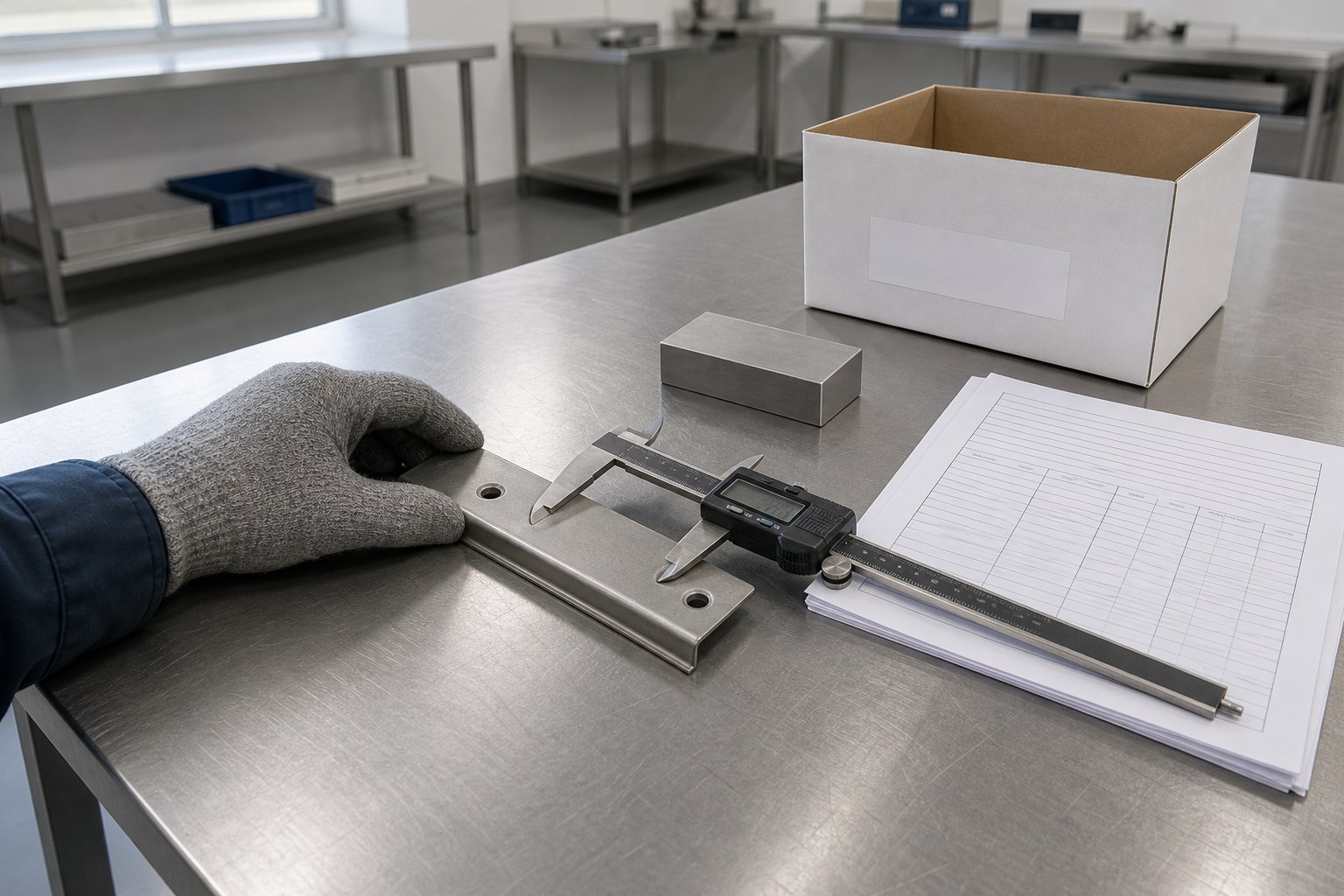
Most sourcing failures are not caused by price. They are caused by approving the wrong thing at the wrong moment: a beautiful sample produced by hand, followed by a production batch produced on a die nobody validated. The buyer approved a part that never existed in production.
This guide is the checklist we would want a buyer to run on us. Every mechanism below is public and free to check, and every specification we state about our own plant is published on this site with an independently verifiable registration number.
Why “good sample, bad production” happens
A sample and a production part are made by different means. A sample is often cut by laser or formed by hand, with an operator watching every feature. A production part comes off a die on a press, and its dimensions are decided by tooling clearance, springback, strip feed and die wear rather than by the operator’s attention.
The difference shows up in exactly the places that matter: wall thickness on a drawn part, hole position after a progressive die has run a few thousand strokes, flatness after bending, burr condition at a sheared edge. None of that is visible in a hand-made sample.
The fix is structural, not a matter of trust. Ask for a first article from the production tooling before you approve volume. Not a sample. A first article.
Step 1 — Get the Chinese legal name and the 18-digit USCC before you discuss price
Every registered Chinese business has two identifiers: its full name in Chinese characters, and an 18-digit Unified Social Credit Code (USCC). Both appear on the business licence, which is a public document. A legitimate manufacturer provides them in writing without hesitation.
With those two strings you can verify the company yourself, for free, in China’s official corporate registry — the National Enterprise Credit Information Publicity System at gsxt.gov.cn. Commercial mirrors (Qichacha, Tianyancha) aggregate the same records with a friendlier interface. A third-party inspection agency charges money to do this; you do not need them for this step.
Check five things, and screenshot each one:
- Status is active (存续 or 在业) — not revoked, cancelled, suspended or in liquidation.
- Registered address matches what the supplier told you.
- Business scope includes manufacturing (生产 or 制造). A licence scoped only to trade or technology services is a trading company.
- Legal representative matches the person you are dealing with, or the supplier can explain the relationship in writing.
- Establishment date is consistent with the history they claim.
Then check litigation separately. The licence being clean does not mean the company is: search the Chinese name on China Judgments Online (wenshu.court.gov.cn) and the China Enforcement Information Platform. A handful of ordinary commercial disputes over many years is normal friction. A pattern of disputes with overseas buyers, multiple enforcement actions, or an entry on the dishonest-enterprise blacklist (失信企业) is a stop signal — that last one means a Chinese court has already determined the company is unwilling to honour its obligations.
If a supplier will not give you the Chinese legal name and the USCC in writing, stop there. There is no legitimate reason for a registered company to withhold them, and without them you have no way to know who you are actually contracting with.
Step 2 — Read the certificate for its scope, not its logo
A quality certificate proves that a management system was audited on a particular date, at a particular site, against a particular scope. It does not prove that the measuring instrument used on your part is calibrated, or that the report you receive came from your parts.
So ask for the certificate itself, and read four fields: issuer, scope, site address, expiry. Then ask for two more things that most buyers never request, and which tell you more than the certificate does:
- The result of the most recent surveillance or recertification audit, including any non-conformances raised and how they were closed.
- Confirmation that the certificate covers the site that will actually make your part, not a sister plant or a group head office.
For a dimensional claim, the evidence is a report, not a sentence. If a supplier states a tolerance, ask for a redacted inspection report from a similar part showing that tolerance on a named feature, with the instrument identified. A tolerance claim is credible on specific features measured on a calibrated machine; it is not a promise about every dimension on the drawing.
Our own registration is published so you can check it rather than believe it: ISO 9001:2015, registration number 34025Q30296R0S, valid 30 May 2025 to 29 May 2028, IAF and CNAS accredited. Verify it with the issuing body. We would rather you did.
If your programme is governed by an additional standard, put it in the enquiry in the first message. It is far cheaper to establish on day one that a supplier cannot certificate your programme than to discover it at the audit.
Step 3 — Confirm it is a factory, not a trading company
Trading companies are not automatically a problem — some add real value in sourcing, consolidation and export documentation. The problem is an unassigned layer: a supplier that presents as a factory, so nobody owns the process parameters when production drifts.
Four checks, all doable from your desk:
- Business scope on the licence: look for 生产 (manufacturing) or 制造 (production).
- Registered address on satellite view (Baidu Maps or Gaode/Amap). An office tower in a city centre is an office. An industrial zone is a plant.
- Registered capital, as a rough signal: manufacturing entities usually carry substantially more registered capital than trading entities.
- Price benchmark against 1688.com, Alibaba’s domestic wholesale platform where Chinese factories sell to the Chinese market. Compare the same process and material. A quote far above the domestic range usually has a middle layer in it; a quote far below the range is its own risk, because something has to give.
Then confirm it live. Ask for a walk from receiving to shipping on a video call — incoming material storage, the machine actually running your process, inspection, and packing. A tour of the showroom and the sample wall answers nothing. Two things worth asking while you are on the call: the model and maintenance record of the machine that will run your part, and the calibration date of the instrument that will measure it.
Step 4 — Ask for a first article from the die, not a polished sample
Define the first article precisely in your purchase order: one part produced from the production tooling, on the production machine, at production settings, measured and reported. Anything else is a sample, and approving a sample does not tell you what production will do.
What the report should contain, line by line: the feature, its nominal value, its tolerance, the actual measured value, and the instrument used. That structure is what lets you compare batch one against batch fifty later.
On a drawn or stamped part, the features that decide whether the batch works are usually not the ones on the drawing’s title block. They are wall thickness through the draw, hole position relative to a datum after several thousand strokes, flatness across a formed face, and burr condition at a sheared edge. Nominate those on the report, and ask what the process naturally holds versus what needs extra tooling time to hold.
A supplier who can produce a first article from the die is telling you something a sample never can: that the tooling exists, that it runs on their own press, and that they are willing to show you the result before you pay for volume.
Step 5 — Assign responsibility for finishing
Most fabricators outsource at least some finishing, and that is normal. What is not normal is finishing with nobody’s name on it. This is where dimensional disputes usually start, because a finish can change a dimension after the part has already been inspected.
For every finish on your part, establish four things in writing:
- Is it done in-house or subcontracted?
- Who inspects the finished result, and against what specification?
- Who holds the finish specification — the thickness, the colour standard, the roughness value?
- Who is liable if the finish changes a dimension, for example a coat build-up on a mating face or a bore closing after plating?
Two finishing sequences are worth pinning down early because they cannot be reversed. Passivation on stainless must come after welding and polishing, or it passivates a surface that is about to be contaminated again. And a brushed or polished grain direction has to be agreed before the part is finished, not after, because refinishing a large panel to a different direction is a remake.
Step 6 — Agree in writing what happens when a lot is rejected
This is the least pleasant section to write into a purchase order and the one that saves the most money. Agree, before the first batch:
- What counts as a defect, against which drawing revision.
- Who measures the disputed feature and on what instrument.
- What evidence both sides will exchange — photographs, inspection reports, retained samples.
- What the remedy is: rework, replacement, or credit, and within what window.
- Who carries the cost of return freight and re-inspection.
The purpose is not distrust. It is to remove ambiguity from the one conversation where ambiguity is most expensive, because it happens on a deadline.
Evidence versus claims: what to ask for, and what a weak answer looks like
| Claim you will hear | Evidence to request | Weak answer |
|---|---|---|
| “We are ISO 9001 certified” | Certificate with issuer, scope, site address and expiry; last surveillance audit result | A certificate image with no scope, no site and no expiry |
| “We hold ±0.005 mm” | Redacted inspection report showing that tolerance on a named feature, with the instrument identified | A general statement, no feature and no report |
| “We are a factory” | Business scope on the licence, registered address on satellite view, live walk from receiving to shipping | A showroom tour and a sample wall |
| “Our sample is approved” | First article from the production tooling, measured and reported, with the tooling identified | A hand-made or laser-cut sample with no die behind it |
| “Full material traceability” | Mill certificate for the lot, linked by lot number to the receiving record and the job | A mill certificate with no link to your parts |
| “We handle finishing” | Named responsibility per finish, in-house or subcontracted, with the specification holder | Photographs of finished parts |
| “Capacity is available” | Which machine, and what share of its hours is committed over the next 60 days | “We have plenty of capacity” |
| “We have done this part before” | A redacted report or case study from a similar part, or the process route explained feature by feature | Adjectives, no artefact |
How to validate the first production batch
Once a supplier passes the checks above, the first batch is where the relationship is actually decided. Run it in this order:
- Freeze the drawing revision. Put the revision level in the purchase order, and require that the revision in the machine program and on the traveller matches it.
- Approve the first article in writing before the run continues. A verbal “looks good” on a video call is not an approval.
- Agree the inspection plan and sampling in advance: which features, how many parts, which instrument, and what happens on a fail.
- Fix the material lot and ask for the mill certificate linked to it.
- Photograph the packed lot before it ships. Packaging is part of the product when parts travel 8,000 km.
- Hold the balance until the goods are confirmed against the agreed plan.
None of this requires an on-site visit. It requires documents and one video session with a fixed agenda. An on-site visit adds observation of housekeeping and workholding, which is real value, but it is not the only way to get evidence.
What we publish so you can check it
We are Nanpi Xinchengweiye Hardware Products Co., Ltd. (XCWY), a metal stamping, deep drawing and sheet metal fabrication plant in Nanpi County, Hebei. Here is what you can verify about us before you send a drawing:
| Item | What we publish |
|---|---|
| Quality system | ISO 9001:2015, registration no. 34025Q30296R0S, valid 30 May 2025 to 29 May 2028, IAF and CNAS accredited — verify with the issuing body |
| Independent assessment | SGS assessed |
| Plant | 15,000 m² in Nanpi County, Hebei; operating since 1998 |
| Metal stamping | 25 to 400 ton presses; progressive, compound and single-station dies; in-house die design, build and maintenance |
| Deep drawing | ±0.10 mm achievable tolerance; in-house tooling |
| Fiber laser cutting | Up to 12,000 W enclosed cell; carbon steel to 25 mm; ±0.05 mm profile tolerance |
| CNC press brake | JFY TPR8-100, 100 ton, 3,200 mm bed; ±0.5° angle tolerance |
| 5-axis CNC machining | HDL-OKK DMU38; ±0.005 mm achievable |
| Welding and assembly | ±0.5 mm typical assembly tolerance, confirmed against the drawing and fixture |
| Materials | SPCC/DC01, Q235, SS304, SS316L, AL5052, galvanized sheet |
| Minimum order | MOQ from 1 piece; single pieces for prototypes and samples |
| Quotation | Quotes returned within 3 business hours once the package is complete |
One honest qualification about tolerances, because it is the claim most often marketed loosely. A tight number like ±0.005 mm is achievable, but it is not free: it dictates tooling, feeds, coolant strategy and inspection time. On most parts only one or two features genuinely need it. Nominate the dimensions that are functional and we will hold those properly, rather than spreading cost across features nobody measures.
For worked examples of how this plays out on real programmes, see the metal enclosure case study, the food-grade stainless hopper case study, the deep-drawn 316L filter housing case study and the BESS enclosure case study.
Where a Chinese fabrication factory is the wrong choice
We hold ISO 9001:2015. We do not hold AS9100D, ISO 13485 or IATF 16949. If your programme requires flight-critical aerospace parts, implantable or high-risk medical devices, or automotive PPAP submissions, we are not the right supplier and we will tell you that rather than quote for work we cannot certificate.
The same applies in two other directions. If you need a finished consumer product with retail packaging and consumer regulatory compliance, that is a different supply chain from component fabrication. And if you cannot share a drawing or a model, even under NDA, nothing useful can be quoted — a verbal description of a part is not enough to price it or to check whether it is manufacturable.
What we need in order to quote
To return a usable quote rather than a range, we need:
- A 3D model (STEP or IGES) or a controlled 2D drawing, with the revision level.
- Material and temper, and any surface finish requirement.
- Quantity, including whether you expect a prototype, a pilot batch and volume.
- Critical dimensions — the ones that are functional, not every dimension.
- Inspection expectation, and any standard governing the programme.
- Assembly context, if the part has to fit something else.
We accept PDF, JPG, PNG, DXF, DWG, STEP, IGES and ZIP packages up to 20 MB. An NDA can be signed on request before you send anything. If the package is complete we target a quotation within 3 business hours; if something is missing or the design has a manufacturing risk, the useful answer is a question back rather than a price, and that is what you will get.
Send a drawing to our fabrication team, or start from the process closest to your part: metal stamping, deep drawing, fiber laser cutting, CNC bending, 5-axis CNC machining, welding and assembly, or surface finishing. If you are still deciding between a factory and a platform, the comparison of XCWY against Xometry and Protolabs sets out where each route is genuinely better.
Frequently asked questions
Related Reading
How do I verify a Chinese metal fabrication factory without visiting it?
Ask for two identifiers first: the company’s full Chinese-character name and its 18-digit Unified Social Credit Code. Verify both in the National Enterprise Credit Information Publicity System at gsxt.gov.cn, checking that status is active, the business scope includes manufacturing, and the registered address matches. Then request the quality certificate with its scope and expiry, a mill certificate linked to a material lot, and an inspection report from a similar part. Finish with one live video walk from receiving to shipping on a fixed agenda.
What is the difference between a sample and a first article?
A sample is usually produced by hand or by laser, with an operator watching every feature. A first article is one part produced from the production tooling, on the production machine, at production settings, measured and reported feature by feature. Only the first article tells you what volume production will do, because a sample has no die behind it.
What does an ISO 9001 certificate actually prove?
It proves that a quality management system was audited on a given date, at a given site, against a given scope. It does not prove that the measuring instrument used on your part is calibrated, or that the inspection report you receive came from your parts. Read the issuer, scope, site address and expiry, then ask for the latest surveillance audit result and the calibration certificates for the instruments used on your part type.
How can I tell a factory from a trading company?
Check four things. The business scope on the licence should include manufacturing (生产 or 制造). The registered address should appear as an industrial zone on satellite view rather than an office tower. Registered capital is usually higher for manufacturing entities. And compare the quote against 1688.com, Alibaba’s domestic wholesale platform, for the same process and material. Trading companies are not automatically a problem, but an unassigned layer between you and the machine is.
Does XCWY accept small orders or sample quantities?
Yes. MOQ starts at 1 piece, and single pieces can be cut, formed or machined for prototypes and samples. Where a process needs dedicated tooling, such as stamping or deep drawing, the practical first step is a first article from the die rather than a one-off sample, so that wall condition and critical dimensions can be approved before a volume run.
Which quality certifications does XCWY hold?
ISO 9001:2015, registration number 34025Q30296R0S, valid from 30 May 2025 to 29 May 2028, IAF and CNAS accredited. We are SGS assessed. We do not hold AS9100D, ISO 13485 or IATF 16949, so aerospace flight-critical, implantable medical and automotive PPAP programmes are outside what we can certificate, and we will say so before quoting.
What files do I need to send to get a metal fabrication quote from China?
Send a 3D model in STEP or IGES, or a controlled 2D drawing with its revision level, together with material and temper, quantity, surface finish requirement, the dimensions that are functionally critical, and your inspection expectation. We accept PDF, JPG, PNG, DXF, DWG, STEP, IGES and ZIP packages up to 20 MB, and an NDA can be signed before you send anything.
How long does a quotation take?
We target 3 business hours once the package is complete. If a critical dimension, a material or a quantity is missing, or if the design carries a manufacturing risk, the useful reply is a question rather than a price, so the first response may be a clarification. Both are faster than a quote that changes after the order.
Who is responsible when a finished part is out of tolerance?
Establish it in the purchase order before the first batch: what counts as a defect and against which drawing revision, who measures the disputed feature and on which instrument, what evidence both sides exchange, what the remedy is (rework, replacement or credit) and within what window, and who carries return freight and re-inspection cost. Ambiguity here is cheapest to remove before production, not on a deadline.
Can a Chinese factory hold plus or minus 0.005 mm?
A tolerance of ±0.005 mm is achievable on selected features with the right machine, tooling, coolant strategy and inspection time, and we run a 5-axis machining centre for that class of work. It is not free, and it is not a sensible blanket tolerance for a whole drawing. Nominate the one or two dimensions that are genuinely functional and expect the supplier to confirm what is realistic on those specific features.
Leave a Reply