The short answer to deep drawing vs metal stamping: choose deep drawing when your part is a seamless hollow shape whose depth is significant relative to its opening — a cup, a can, a sensor housing, a one-piece enclosure body. Choose metal stamping when your part is essentially flat, shallow, or defined by cut features and bends — a bracket, a clip, a contact, a cover panel. The dividing question is not “how complex is it” but “does the material need to flow into a new three-dimensional volume, or only be cut and bent?”
That distinction matters because the two processes fail in completely different ways. Stamping problems are usually about springback, burrs and feature position. Drawing problems are about wall thinning, wrinkling and tearing — the material physically running out of ductility. A supplier who is good at one is not automatically good at the other, which is exactly why the deep drawing vs metal stamping decision usually gets made too late, after tooling is already being cut.
This guide sets out how to make the call early, using geometry, volume and tolerance rather than guesswork.
What each process actually does to the metal
Metal stamping
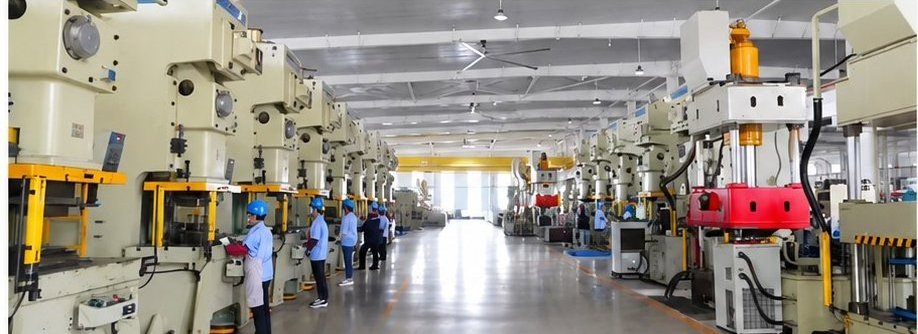
Stamping covers a family of operations performed on a press: blanking, piercing, notching, coining, embossing, forming and shallow bending. The blank is cut from strip or coil and the geometry is created by shearing and localised bending. Material thickness stays broadly constant — the sheet is cut and folded, not stretched into a new shape.
Because the deformation is localised, stamping runs fast, holds tight positional tolerances, and tolerates a wide range of materials. Typical production tolerance for a well-toleranced stamped feature is around ±0.05 mm at XCWY, with press capacity from 25 to 400 tons covering everything from small contacts to heavy structural stampings.
Deep drawing
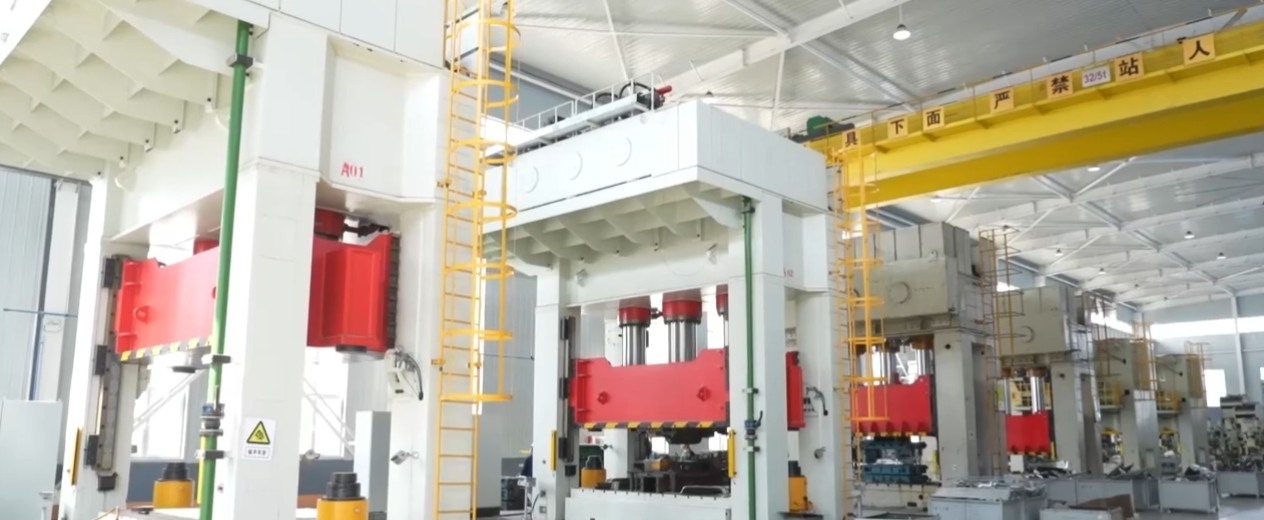
Deep drawing is a stretching and flow process. A blank is clamped by a blank holder and a punch pushes it through a die, drawing the flange material inward to form a wall. The metal genuinely changes shape in three dimensions: the flange gets pulled in, the wall thins, and the corner radius carries the highest strain.
A part is generally described as “deep drawn” rather than merely “formed” once the depth exceeds roughly half the diameter. Beyond that point, a single stroke will not do it and the part needs redraw stages. Our deep drawing line runs multi-stage forming with typical tolerances around ±0.10 mm — looser than stamping, and that gap is a direct consequence of the physics, not of machine quality.
Geometry decides first: the draw ratio test
Before comparing cost, test the geometry. The limiting draw ratio (LDR) is the maximum ratio of blank diameter to punch diameter that a material can survive in one draw. For most steels and aluminium alloys, a first draw of roughly 1.8 to 2.2 is realistic; austenitic stainless can be pushed harder because of its high work-hardening capacity, while high-strength or low-elongation alloys must be kept lower.
Two practical consequences follow:
- Depth-to-diameter drives stage count. A shell 30 mm across and 15 mm deep is usually a single-draw part. The same 30 mm diameter at 60 mm deep needs several redraws, each with its own tooling and setup.
- Each redraw reduces diameter by a limited percentage. Successive draws are progressively less aggressive than the first, because the metal has already work-hardened. Interstage annealing may be required for deep parts in stainless.
If the part is shallow, none of this applies and stamping is almost always the cheaper route. If the part is deep, no amount of press tonnage substitutes for correct stage planning.
Deep drawing vs metal stamping: the decision table
| Criterion | Metal stamping | Deep drawing |
|---|---|---|
| Typical geometry | Flat, shallow-formed, bent, pierced | Seamless hollow shells, cups, cans, deep housings |
| Depth guideline | Depth below roughly 0.5 × width | Depth above roughly 0.5 × diameter |
| Wall thickness | Essentially uniform | Thins in the wall, thickest at the flange |
| Typical tolerance (XCWY) | ±0.05 mm | ±0.10 mm |
| Dominant failure modes | Springback, burr, feature position drift | Wrinkling, tearing, earing, excessive thinning |
| Tooling complexity | Low to high depending on die type | High — multi-stage sets, blank holder control |
| Cycle speed | Fast, especially on progressive tooling | Slower, particularly with multiple redraws |
| Seams and leak paths | Present if assembly is welded | None in the drawn body |
| Best-fit volume | Medium to very high | Medium to high — tooling must amortise |
Deep drawing vs metal stamping on tooling cost and volume
Both processes are tooling-led, but the shape of the investment differs. Stamping tooling scales with the number of operations you combine: a single-stage blanking die is modest, a compound die more, a progressive die significantly more because every station must be built and timed together. The payoff is cycle rate — a progressive die produces a finished part per stroke.
Drawing tooling scales with the number of stages the draw ratio forces on you. A single-draw part can be surprisingly economical. A four-stage part carries four punch-and-die sets plus trim tooling, and that cost lands whether you order 5,000 pieces or 500,000.
The practical implication for the deep drawing vs metal stamping trade-off is this: a shallow part that could be drawn will nearly always be cheaper stamped, but a deep part that someone tries to fabricate from cut-and-welded panels will accumulate labour on every single piece. Tooling is a fixed cost; welding and grinding are recurring costs. Volume decides which one hurts more.
When a welded assembly beats a drawn part
For enclosure-style parts this is the same trade-off covered in our guide to welded vs deep drawn enclosures. In short, welding wins when:
- Annual volumes too low to amortise multi-stage draw tooling.
- Geometry outside drawing limits — very large, very deep, or sharply rectangular with tight corner radii.
- Frequent design revisions, where committing to hard tooling is premature.
- Parts requiring internal structure or partitions that cannot be formed from one blank.
When a drawn part beats a welded assembly
- The part must be leak-tight or pressure-retaining; every weld seam is a potential leak path.
- Cosmetic appearance matters and you would otherwise pay to grind and polish weld seams.
- Repeat volumes are stable, so the tooling cost divides down.
- Consistency matters more than flexibility — a drawn shell repeats identically, whereas welded assemblies carry operator variation and distortion.
Material behaviour: what draws well and what does not
Formability is governed mainly by elongation, the strain-hardening exponent and planar anisotropy. Practically:
- Deep-drawing-quality low carbon steel is the reference material — high elongation, predictable flow.
- Austenitic stainless 304 draws well and work-hardens strongly, so it tolerates deep shapes but may need interstage annealing; 316/316L behaves similarly with slightly higher forming loads. The grade comparison matters here — see our guide to 316 vs 316L stainless steel.
- Aluminium 1050, 3003 and 5052 draw well; 6061-T6 does not — its low ductility in the T6 temper makes it a poor drawing candidate and it also demands generous bend radii.
- Copper and brass are excellent drawing materials with high ductility.
- Spring steels and high-strength alloys are stamping materials, not drawing materials.
Earing — the wavy edge produced at the open end of a drawn part — comes from planar anisotropy in the rolled sheet and is normal. It is dealt with by adding trim allowance, not by pretending it will not occur. Material selection details for both routes are summarised on our materials reference.
Tolerances: set them where they do work
The most expensive drawings we see apply one tight tolerance band to every dimension. On a drawn part, the achievable tolerance is not uniform across the geometry: the punch-side internal diameter is the most controlled dimension, the open-end diameter is looser, and wall thickness varies by design because the material thinned to get there.
Specify tightly where a bearing fits, a seal seats or a mating part locates. Allow general tolerances elsewhere. On stamped parts the same principle applies to hole-to-hole positions versus outline dimensions. Doing this well typically removes more cost than any material substitution, and it is exactly what a design-for-manufacture review is for.
A practical decision sequence
The deep drawing vs metal stamping decision rarely needs to be difficult when you work through the geometry first.
- Measure depth against width or diameter. Below roughly 0.5, plan for stamping.
- If deeper, estimate draw stages from the draw ratio and check the material will tolerate them.
- Ask whether the part must be leak-tight or seam-free. If yes, weight the answer heavily toward drawing.
- Compare tooling investment against per-part labour at your realistic annual volume, not your optimistic one.
- Re-check tolerances against function and relax everything that is not functional.
- Confirm the supplier runs both processes in-house, so the recommendation is not shaped by what they happen to own.
That last point is not incidental. A shop with only presses will propose a stamped-and-welded assembly; a shop with only draw tooling will propose a drawn part. Both processes run under one ISO 9001:2015 (ISO 9001) system at our plant, which means the process route can be chosen on engineering merit.
Frequently Asked Questions
What is the difference between deep drawing and metal stamping?
Deep drawing forms a flat blank into a seamless hollow shape by drawing material through a die, while metal stamping cuts and bends sheet without significantly changing wall thickness. Drawing changes the part’s three-dimensional volume; stamping changes its outline and adds bends. The practical divide is part depth relative to width.
At what depth does a part need deep drawing instead of stamping?
As a working rule, once depth exceeds about half the part diameter or width, the part moves into deep drawing territory. Below that, a shallow form on a press is usually sufficient and cheaper. The exact threshold depends on material ductility and corner radii.
Which is cheaper, deep drawing or metal stamping?
For shallow parts, stamping is almost always cheaper because the tooling is simpler and the cycle is faster. For deep, seamless parts, deep drawing usually wins on total cost because the alternative is a welded assembly that carries labour on every piece. The crossover depends on annual volume and how many draw stages the geometry forces.
Why do deep drawn parts have thinner walls than the original sheet?
Thinning is inherent to the process: material is stretched as it flows into the wall, and it is thinnest just above the punch corner radius where strain is highest. Good tooling design controls where thinning occurs rather than eliminating it. If a minimum wall thickness is functionally critical, state it on the drawing so blank thickness can be selected accordingly.
What tolerance can I expect on a deep drawn part?
Around ±0.10 mm is a realistic production tolerance for our drawn parts, compared with roughly ±0.05 mm for stamped features. Tolerance is not uniform across a drawn geometry — the punch-side diameter is the best controlled, the open end the least. Secondary machining can tighten a specific feature where function requires it.
Can both processes be combined on the same part?
Yes, and it is common. A shell can be drawn, then pierced, trimmed, embossed or coined on a press, and finished with hardware insertion or welding for features that cannot be formed. Combining routes is usually how the cheapest overall part is produced.
Send the drawing and we will tell you which route fits
If the deep drawing vs metal stamping question is still open for your part, the fastest way to resolve it is to have an engineer look at the actual geometry. We return a quotation within 3 business hours, together with free design-for-manufacture feedback covering draw ratio, stage count and any tolerances that are adding cost without adding function. Send your drawing to xcwystamping@xcwybj.com or use the quote request form.
Need a decision on your part?
Send your drawings for an engineering review — pricing plus DFM feedback within 3 business hours. MOQ from 1 pc, NDA on request.
Leave a Reply