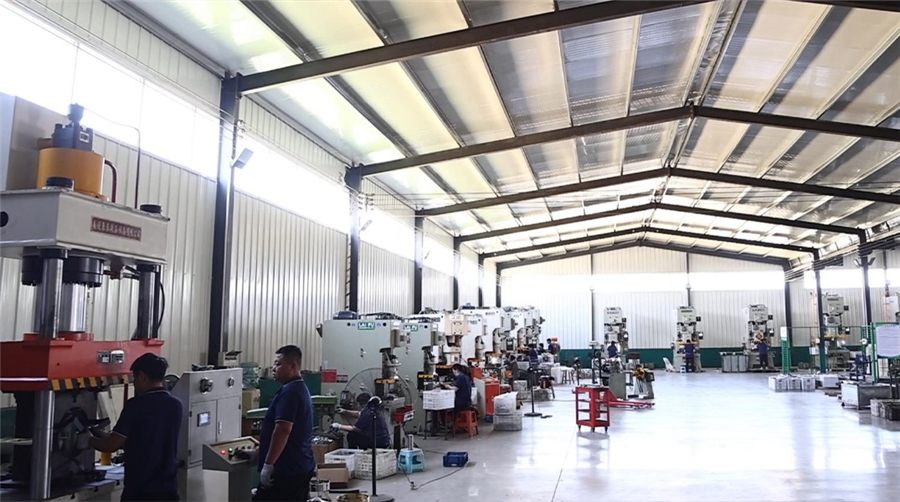
The sheet metal fabrication vs CNC machining decision follows from one property of the part: is the geometry essentially a folded surface, or is it a solid body with internal features? Sheet metal starts with flat stock and creates shape by cutting and bending it. CNC machining starts with a solid block or bar and creates shape by removing material. Those two starting points lead to completely different cost structures, tolerances and design rules.
As a working rule, if the part has a roughly constant wall thickness and could be unfolded into a flat pattern, fabricate it. If it has varying thickness, internal pockets, threaded bosses, complex three-dimensional surfaces or tolerances tighter than about ±0.1 mm across the whole part, machine it.
The interesting cases are the ones in between, where either route is technically possible. Those are usually decided by volume, tolerance on a small number of critical features, and how much material would end up as chips.
Sheet metal fabrication vs CNC machining: what each process does
Sheet metal fabrication
Flat stock is cut — normally by laser — then bent on a press brake, welded where needed, fitted with hardware and finished. Material thickness stays constant throughout, because the process folds a surface rather than carving a solid.
The number of operations, rather than material removal, drives the economics. A part with four bends and six holes is cheap; the same part with thirty bends and a welded sub-frame is not. Our fabrication chain runs 0.3 to 6.0 mm sheet, with bends up to 3,200 mm long and bend angle tolerance of ±0.5° as standard.
CNC machining
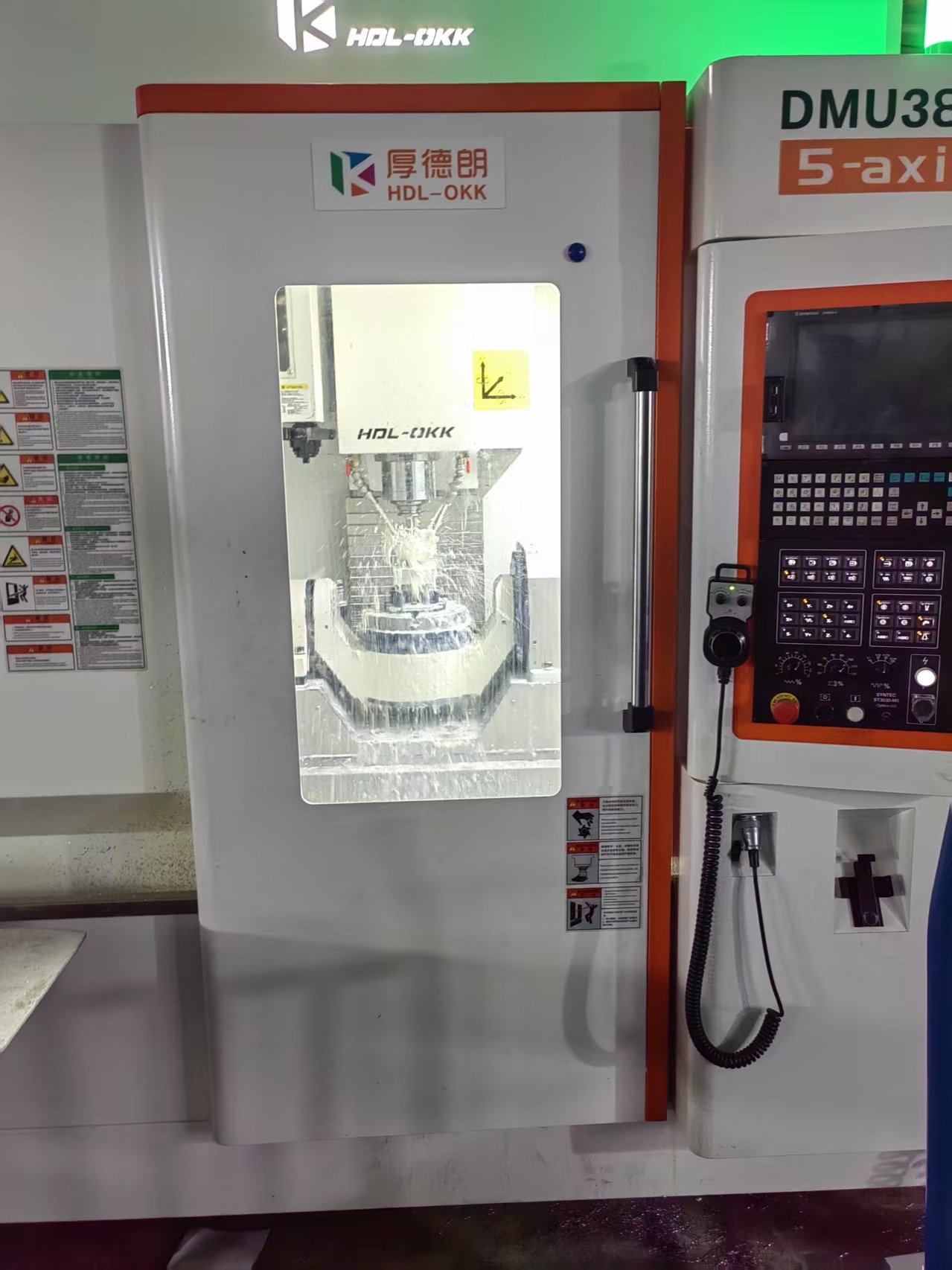
A cutting tool removes material from solid stock under numerical control. Three-axis machining handles prismatic parts requiring multiple setups; simultaneous five-axis machining reaches complex geometry in a single setup, which eliminates the cumulative error that comes from re-fixturing.
Here, cycle time and the volume of material removed drive the economics. Machining holds far tighter tolerances than fabrication — our HDL-OKK DMU38 five-axis centre works to ±0.005 mm — but every cubic millimetre removed is paid for twice, once as purchased stock and once as machine time.
Decision table
The table below summarises how the sheet metal fabrication vs CNC machining trade-offs land for typical part families.
| Criterion | Sheet metal fabrication | CNC machining |
|---|---|---|
| Starting material | Flat sheet or coil | Solid block, plate or bar |
| Wall thickness | Constant, 0.3 – 6.0 mm typical | Variable by design |
| Typical tolerance | ±0.1 – 0.5 mm; ±0.5° on bends | ±0.02 mm standard, ±0.005 mm precision |
| Material utilisation | High — nesting minimises offcut | Low — most of the block becomes chips |
| Internal features | Limited — no pockets or blind cavities | Pockets, bores, threads, undercuts |
| Complex 3D surfaces | No | Yes, especially five-axis |
| Large enclosures and panels | Well suited | Impractical and costly |
| Cost at low volume | Low — no tooling | Moderate — programming and fixturing |
| Cost at high volume | Falls with batching | Falls slowly — cycle time is fixed |
| Minimum quantity | Prototypes upward | Genuinely viable from one piece |
| Strength approach | Stiffness from geometry — flanges, ribs | Strength from solid section |
| Weight | Light for the volume enclosed | Heavier unless material is removed deliberately |
Tolerance: where fabrication genuinely cannot compete
Fabrication tolerances accumulate. Each bend carries angular variation, and each subsequent bend inherits the position error of the one before it. Across a part with several bends, the tolerance stack-up on a final feature can be substantially larger than any single operation’s tolerance.
Machining does not accumulate error in the same way, because features are cut from a datum that does not move within a setup. Five-axis machining extends that advantage by reaching multiple faces without re-fixturing.
The practical consequence is not “machine the whole part”. It is that a critical interface on an otherwise fabricated part can be machined afterwards. A bearing bore, a sealing face, a precisely located mounting pattern — fabricate the body, then machine the one feature that needs to be right. This hybrid is usually far cheaper than machining the entire part from solid, and it is where most of the avoidable cost in this comparison hides.
Material waste and its real cost
The difference in material utilisation is larger than most cost models capture. Laser cutting nests parts closely and the shop recycles the skeleton, so utilisation stays high. Machining a bracket from solid can turn most of the purchased block into chips, and on expensive alloys such as 7075 or 316 stainless that waste dominates the part cost.
Three implications follow:
- The higher the material cost per kilogram, the more strongly the sheet metal fabrication vs CNC machining comparison favours fabrication.
- As the part’s bounding box grows relative to its finished volume, machining looks progressively worse.
- Near-net starting stock — plate close to final thickness, or a fabricated blank — recovers much of the difference when machining is unavoidable.
Sheet metal fabrication vs CNC machining across volume
Neither process requires hard tooling, which is what distinguishes both from stamping. But their volume curves still differ.
Fabrication cost falls meaningfully with batch size. Nesting improves, press brake setups amortise across more parts, and handling becomes more efficient. Moving from ten parts to a thousand produces a real per-part reduction.
Machining cost falls more slowly. Programming and fixturing amortise, and a good programmer can shorten the cycle, but the machine still has to remove the same material from every piece. Beyond a certain volume the curve flattens because cycle time is irreducible.
This is why machining is excellent for one-off precision parts and progressively less attractive as volume grows, while fabrication improves with volume and eventually gives way to stamping when volumes justify hard tooling. If your quantities are heading into the thousands and the part is a formed sheet component, the comparison to run next is fabrication against stamping, not against machining. Certification is a separate axis: our guide to ISO 9001 vs ISO 13485 vs IATF 16949 explains which certificates actually matter for your buyer.
Design rules that decide the outcome
Design for fabrication
- Keep wall thickness constant — that is the process’s defining assumption.
- Use a consistent bend radius throughout, ideally one that matches standard tooling.
- Respect minimum flange height, roughly four times material thickness plus the inside radius, or the flange slips into the die.
- Keep holes at least two material thicknesses from a bend line to avoid distortion.
- Add stiffening geometry — flanges, ribs, embossments — rather than increasing thickness.
- Use self-clinching hardware for threads instead of tapping thin sheet.
Design for machining
- Internal corner radii should be as large as function allows; sharp internal corners require small tools and long cycles.
- Limit pocket depth relative to tool diameter — deep narrow pockets need long tools that chatter.
- Standardise hole sizes to reduce tool changes.
- Minimise the number of setups; each one adds cost and a tolerance stack.
- Apply a general tolerance class such as ISO 2768 and avoid tight tolerances on non-functional features, since inspection cost rises with them.
- Consider whether a thinner near-net starting stock would remove machining time.
When to combine both
The lowest-cost answer is frequently a hybrid, and identifying it early is the highest-value part of a design review.
- Fabricated body, machined interface. A sheet metal chassis with one machined mounting face where alignment is critical.
- Fabricated enclosure, machined inserts. A sheet housing with machined bosses welded or pressed in where threads must carry load.
- Machined part, fabricated brackets. A precision core assembly with fabricated mounting hardware around it.
- Post-machining after welding. Weld the assembly, then machine the critical features so the final cut removes welding distortion rather than tolerating it.
That last option is underused. Machining before welding almost always lets the precision feature move; cutting it after welding costs a setup but delivers a part that actually sits within tolerance.
Frequently Asked Questions
Which is cheaper, sheet metal fabrication or CNC machining?
Sheet metal fabrication is usually cheaper for parts that can be made from folded flat stock, because material utilisation is high and cycle times are short. CNC machining wins when the part needs internal features, varying thickness or tolerances tighter than fabrication can hold. The gap widens with expensive alloys, where machining waste dominates cost.
What tolerance can sheet metal fabrication hold?
Expect roughly ±0.1 to ±0.5 mm on dimensions and ±0.5° on bend angles as standard, with tighter angle control available on request. Tolerances accumulate across multiple bends, so a feature at the end of a long bend sequence carries more variation than a single operation would suggest. Machine any individual feature that needs to be tighter.
Can a part be both fabricated and machined?
Yes, and it is often the cheapest route. A common pattern is to fabricate the body and machine only the one or two features requiring precision, such as a bearing bore or sealing face. Machining after welding also removes distortion that would otherwise put the feature out of tolerance.
When does CNC machining make sense for low quantities?
Machining is genuinely viable from a single piece because no tooling is required — only programming and fixturing. That makes it well suited to prototypes, fixtures, one-off precision components and spares. Fabrication is also tooling-free, so for low quantities the choice returns to geometry and tolerance rather than volume.
Does machining waste much material?
Yes, often substantially. Machining a part from solid can convert most of the purchased block into chips, whereas laser nesting on sheet keeps utilisation high. On costly alloys such as 7075 aluminium or 316 stainless, this waste can be the largest single element of part cost.
Which process is better for enclosures?
Sheet metal fabrication, in almost all cases. Enclosures are thin-walled, large in area and low in structural mass, which is exactly what folding flat stock is good at. Machining an enclosure from solid would remove most of the material and cost far more.
Send the model and we will recommend a route
If a part could plausibly go either way, the fastest way to resolve it is to have both processes assessed against the same geometry by people who run both. Send a STEP file or drawing and an engineer will recommend a route, flag any features driving unnecessary cost and return a quotation within 3 business hours. Email xcwystamping@xcwybj.com or use the quote request form.
Need a decision on your part?
Send your drawings for an engineering review — pricing plus DFM feedback within 3 business hours. MOQ from 1 pc, NDA on request.
Leave a Reply